The Quiet Shift in Self-Publishing: Platforms, Scams, and the Rise of Direct-to-Reader Marketing


Spend enough time in author communities and the same stories keep coming up. The "marketing campaign" that cost four figures and turned out to be two templated emails. The distributor that sat on a takedown request for two months. The contract someone signed in 2021 that still controls their audiobook rights.
None of these people were careless. Most of them just compared royalty percentages, liked what they saw, and signed. The percentage is the one number every platform puts in its marketing, and it's usually the least important thing in the contract.
This guide is about the rest of the contract: what to check, what to ask for in writing, and how to build a readership that doesn't disappear when a platform changes its rules.
First, figure out what you're actually buying
Publishing companies have a habit of using the same words to sell very different things. "Platform" might mean a retailer, a distributor, a services company, or a piece of software. So before you compare prices, work out what job the company actually does.
A retailer or distributor makes your book available in stores. A services company sells editing, cover design, formatting, or ad management. A newsletter tool gives you a way to contact subscribers. A direct-sales tool lets you take payments on your own site.
These don't overlap as much as the sales pages imply. The company formatting your ebook isn't necessarily distributing it anywhere. The distributor putting your book in forty stores isn't marketing it in any of them. Plenty of authors have paid for one of these jobs believing they were getting three.
Once you know what job you're paying for, you can start asking the harder questions:
- Discoverability: how readers actually find books on the platform
- Payout timing: when money becomes payable, and what gets deducted first
- Contract language: whether you're granting a license or signing away rights
- Rights and reversion: how fast you can remove a book, and what happens to your files
- Customer ownership: whether you can ever contact your own buyers
- Support and exit terms: who answers when something breaks, and what leaving costs
Every one of those maps to a row in the checklist below.
The vetting table
Copy this into a spreadsheet before you sign anything, and fill it in from the contract and written answers - not from what a sales rep told you on a call. Calls are where promises live; contracts are where they die.
| Area | Questions to answer | Evidence to ask for |
|---|---|---|
| Upfront and recurring fees | What do I pay before launch? Are there renewals, storage charges, or account fees later? | Itemized fee schedule and renewal terms |
| Royalty calculation | Is the percentage based on list price, net receipts, or profit after deductions? Who absorbs delivery costs, refunds, and payment processing? | The contract's royalty definition, plus a sample statement |
| Payment schedule | When are royalties reported and paid? Is there a minimum threshold or a reserve? | The payment clause and a sample payment report |
| Rights granted | Am I licensing specific rights or assigning them? Which formats, territories, and languages? | The full agreement and rights schedule |
| Rights retained | Can I publish elsewhere, sell direct, license audio, do translations? | The exclusivity and reserved-rights clauses |
| Lock-in | Is there a minimum term? Is exclusivity limited to a format or channel? | Termination and exclusivity language |
| Distribution destinations | Which stores, libraries, and countries are actually included? | A current destination list |
| Takedown and refunds | How long does removal take? Who controls refunds? What happens to print inventory? | The post-termination clauses |
| Marketing claims | What does "promotion" or "featured" mean in measurable terms? | Written scope, dates, placements, reporting |
| Guarantees | Is anything actually guaranteed and what's the remedy if it fails? | The guarantee, in writing |
| Support | Who fixes metadata errors and payment disputes? a person or a ticket queue? | Support hours and escalation process |
| Disputes | Which law applies? Is there forced arbitration? | Governing-law and dispute clauses |
| Author control | Can I change price, cover, description, and release date without asking permission? | Account permissions in the actual product |
One thing worth saying about this table: a company that won't give you a sample contract or a complete fee schedule has already answered your most important question. You don't need to figure out whether they're hiding something. The refusal is the information.
Red flags
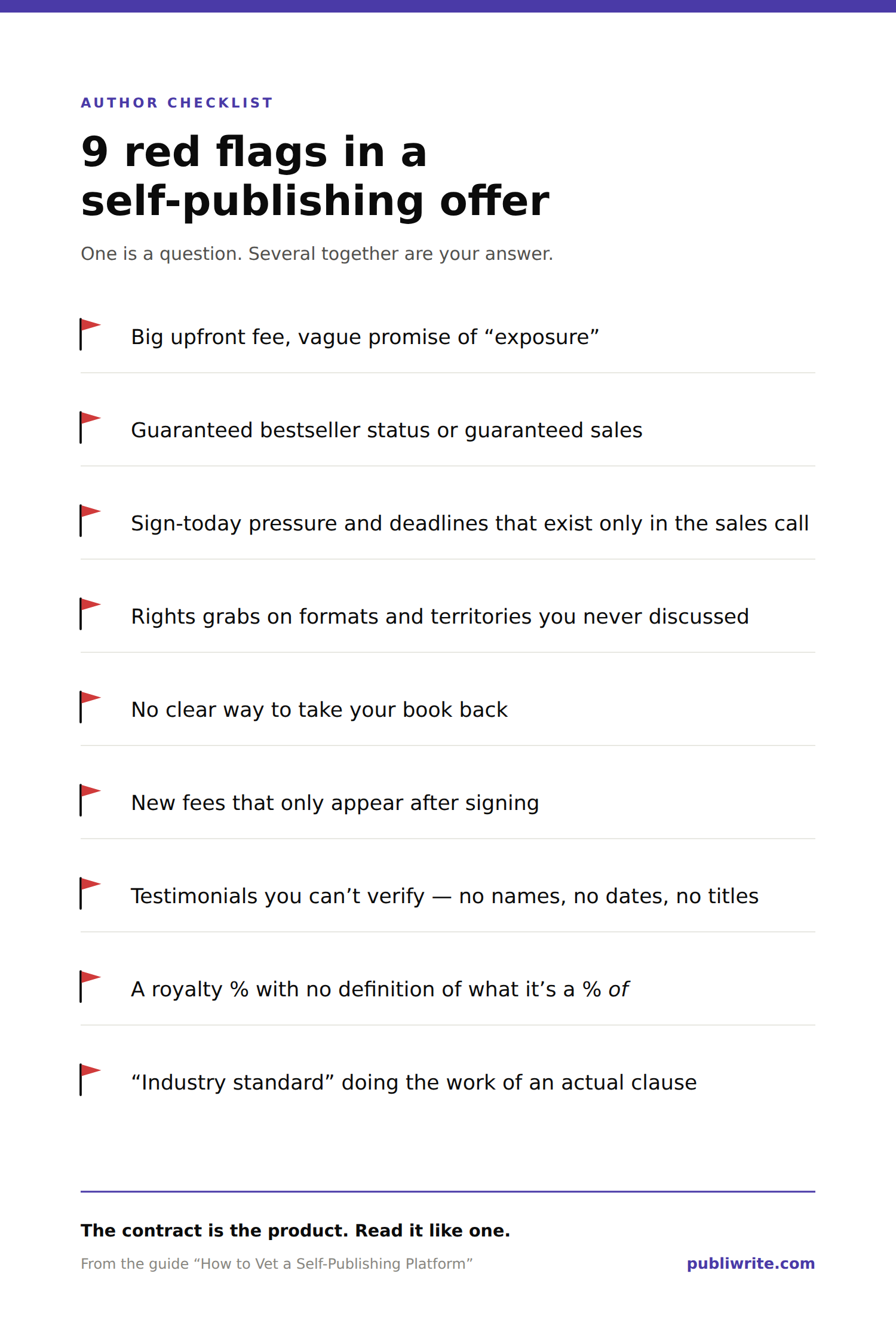
No single item here proves anything. A few of them together should slow you down considerably:
- A large upfront fee attached to vague promises of "exposure" or "visibility"
- Guaranteed bestseller status or guaranteed sales
- Pressure to sign on one call, or a discount deadline that only exists inside the sales process
- Rights grants covering formats and territories nobody discussed with you
- No clear takedown or reversion procedure
- Fees that appear after signing: editing, "premium" placement, renewals
- Testimonials with no names, dates, or book titles you can check
- A royalty percentage with no explanation of what it's a percentage of
- Contracts that lean on "industry standard" instead of defining the obligation
And don't let a polished website do the vetting for you. Decent web design costs a few hundred dollars; it proves nothing. Search the company's legal name, not just the brand. Save dated screenshots and PDFs of every claim, because websites change and contracts don't have to match what the homepage said in March.
Expensive isn't the same as predatory
An upfront fee doesn't make a company a scam. Authors pay for editing, covers, formatting, audiobook production, and ad management all the time, and a transparent provider can charge a lot and still deliver exactly what it promised.
The difference usually shows up in the relationship between the price, the deliverable, and the evidence. A legitimate service tells you what it will do, what it costs, who owns the files afterward, and how the relationship ends. An expensive-but-legal service might charge more than your book will ever earn back - poor value, but your call to make. The predatory pattern is different: vague deliverables, inflated claims, unclear rights, urgency, and costs that surface after you've signed.
This isn't a hypothetical concern. In 2026 the FTC finalized an order against Publishing.com, a company that sold self-publishing courses and services, over allegations it misled consumers about how much money they could expect to earn - the settlement included a $1.5 million payment. And Writer Beware, a project sponsored by the Science Fiction and Fantasy Writers Association and run for years by Victoria Strauss, maintains an ongoing record of publishing schemes, questionable contracts, and impersonation scams aimed at authors. Both are worth reading directly:
A note on tone: the useful skill here is pattern recognition, not public accusation. A company can be legitimate and still be a bad deal for your particular book. It can also deserve heavy scrutiny without you having enough evidence to call it fraud. You don't need a verdict. You just need to decide whether to sign.
Where we fit in (a disclosure)
This guide is published by PubliWrite, so you should apply the same scrutiny to us that we're recommending for everyone else. Here's the shape of it.
PubliWrite gives authors tools to write, prepare, and publish a book, and finished books reach readers through PubliRead, our own marketplace. We are not a multi-retailer distributor - we don't push your book to Amazon or IngramSpark, and you shouldn't evaluate us as if we did (right now, we might do in the future). The relationship is non-exclusive: you keep full copyright and can publish or sell the same book anywhere else. Books can be produced as ebook, PDF, paperback, or hardcover. Earnings are held for 45 days (the buyer refund window) and can then be withdrawn any time, with no minimum payout. One limitation worth knowing upfront: editing or removing a published book isn't self-serve yet - you have to contact us.
Measuring the gap between promise and proof
Here's a habit that formalizes what experienced authors already do instinctively. For any offer you're considering, score two things per category on a 0–5 scale: what the sales material implies, and what you can actually verify from the contract, sample reports, and product. The distance between the two numbers is the promise gap.
Say a "launch acceleration package" implies national retail visibility (5), expert marketing support (4), transparent reporting (4), full rights retained (5), reliable delivery (4), and author control (4). Then you read the contract. No retailers are named (1). "Marketing support" turns out to be two templated emails (2). There's no sample report (1). The agreement quietly takes an exclusive license on several formats (2). Deliverables have no dates (2). Takedown requires written approval with no deadline (1).
Promised: 26. Verified: 9. That 17-point gap doesn't prove anyone committed a crime. What it tells you is that the offer is asking you to trust marketing more than evidence - and at that point you renegotiate, pay a lawyer to read the contract, or walk.
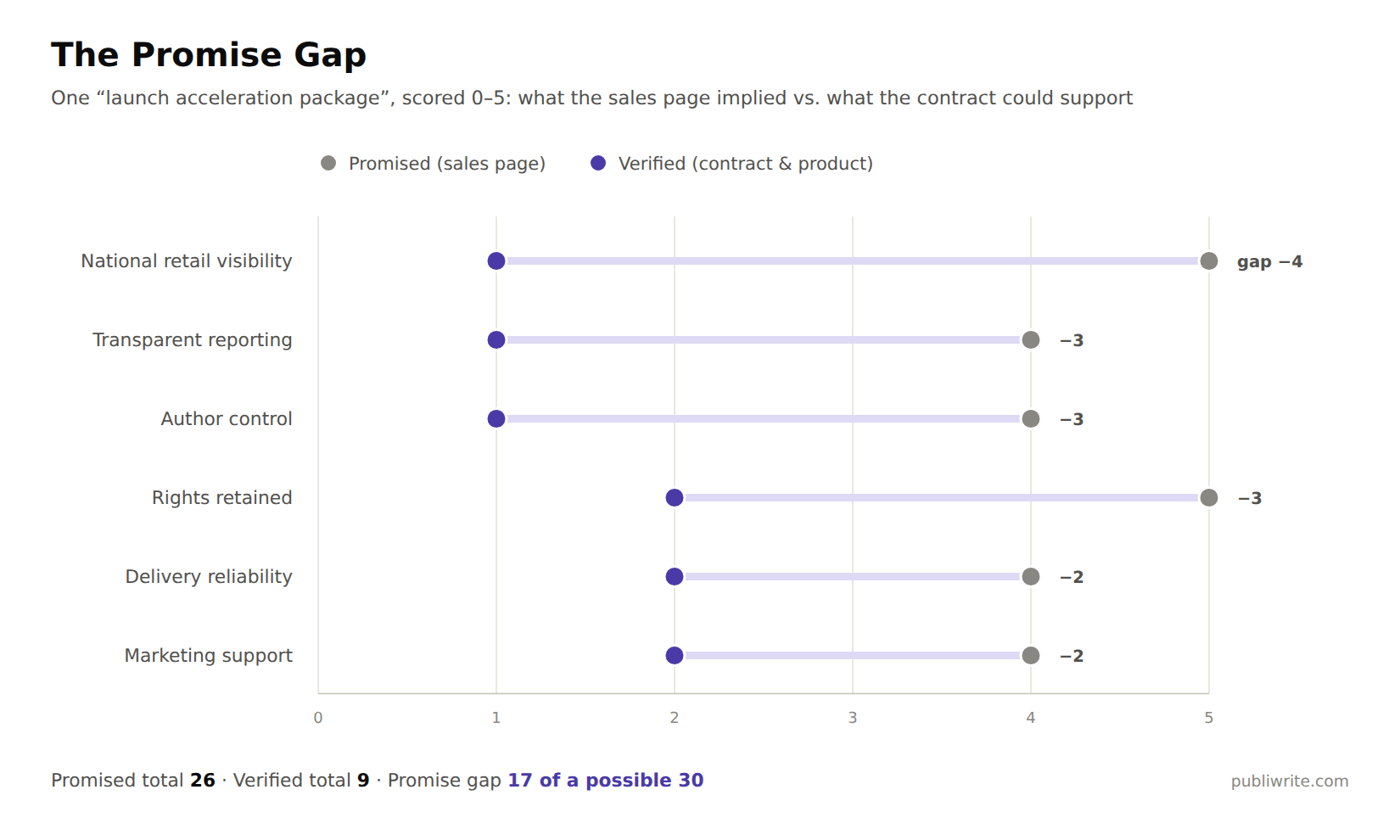
The scores are subjective, obviously, and some categories matter more than others depending on your situation - rights clauses can hurt you for a decade, while a fuzzy reporting schedule is merely annoying. Treat it as a structured way to notice where the evidence is thin, not as a rating system. If you do use it, score the offer again after signing, after delivery, and after your first payment report. Whether the promise survives contact with reality is the real test, and it only happens after the money moves.
The other half of the problem: renting your entire audience
Vetting platforms protects you from bad actors. It doesn't protect you from a subtler problem, which is that even the good platforms own the relationship with your readers. Amazon knows who bought your book; you don't. An algorithm change can cut your visibility overnight without anyone doing anything wrong.
The fix isn't abandoning retailers; for most authors that would be commercial suicide. The fix is making sure some meaningful slice of your readership can be reached by you, directly, with permission. In practice that means an email list, an author website, and clear pathways from your books to both.
Think of discovery as four channels that feed each other:
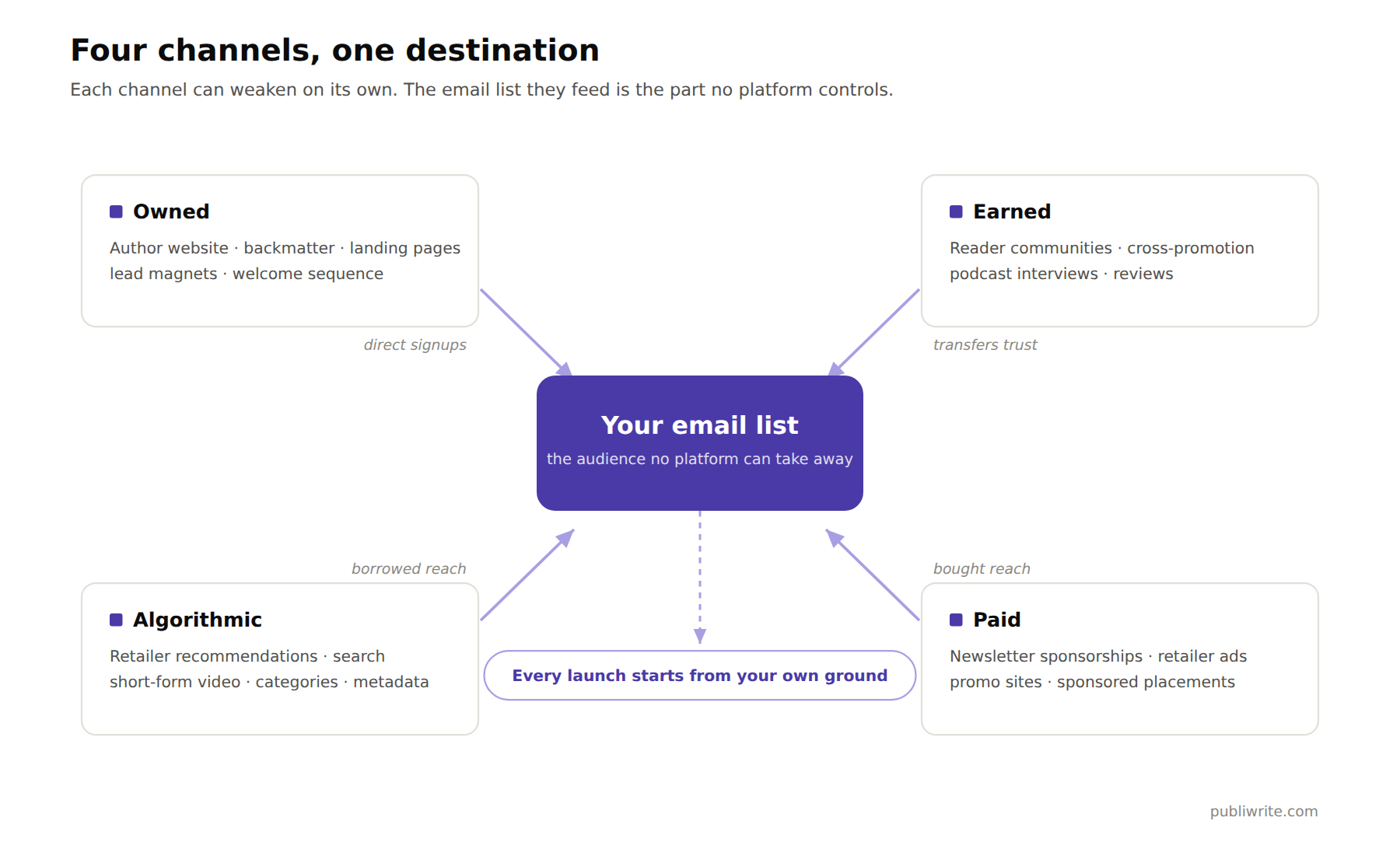
Owned: your website, newsletter, welcome sequence, and backmatter. This is the part nobody can take away. The classic move is a lead magnet: a bonus epilogue for romance readers, a world guide for fantasy, a worksheet for nonfiction. Make the signup promise specific - "get the free story that follows The Glass Harbor" beats "join my newsletter" every time then deliver it immediately. And give readers one next step. Someone who just finished your book shouldn't face a menu of six social links, a Patreon, and three signup forms.
Earned: other people choosing to recommend you: reader communities, cross-promotion with authors in your genre, podcast interviews, reviews. Slower than buying ads, but it transfers trust in a way paid reach can't. The unglamorous truth is that it requires showing up in communities as a reader first. Nobody has ever built an audience by pasting a sales link into a Facebook group.
Algorithmic: retailer recommendations, search, short-form video, anything where a system decides who sees you. Use accurate categories, clear series order, and descriptions that tell the right reader "this is for you" in the first line. But treat algorithmic reach as borrowed, because it is. Its best use is converting temporary visibility into owned relationships - with one caveat: check each retailer's actual rules before building a funnel off its platform, because policies on backmatter links and review incentives vary and are enforced.
Paid: newsletter sponsorships, retailer ads, promo sites. Start with a budget you can afford to lose completely, change one variable at a time, and track cost per subscriber and cost per sale even though attribution will never be clean. One honest complication: a campaign that loses money on book one can still be worth running if read-through to the rest of the series makes the math work. Judge the series, not the ad.
The legal bit, briefly
Only email people who opted in. Bought and scraped lists aren't a shortcut; they're a deliverability problem and, depending on where your subscribers live, a legal one - CAN-SPAM in the US, GDPR in the EU and UK, CASL in Canada. The common thread across all of them: a working unsubscribe link, an honest sender identity, and a record of how consent happened. A free download authorizes you to send what you promised, not to sell the address or keep mailing after someone unsubscribes. For anything more elaborate than a basic newsletter, that's a conversation with a lawyer, not a blog post.
Beyond compliance, the sequencing matters. A signup is permission to start a relationship, not to start selling. Deliver the thing you promised first. Send something worth reading second. Make an offer somewhere around the fifth email, not the first. Readers can tell the difference between an author who wants readers and an author who wants transactions, and they behave accordingly.
One more caution: don't borrow another genre's benchmarks. Romance lists behave nothing like literary fiction lists; a 1,000-person organically grown list will outperform a 20,000-person giveaway list on every metric that matters. Compare against your own history first, and treat any statistic that arrives without a source, date, genre, and definition as trivia.
A 90-day plan
You don't need to rebuild everything this month. Ninety days is enough to move from fully rented to partially owned.
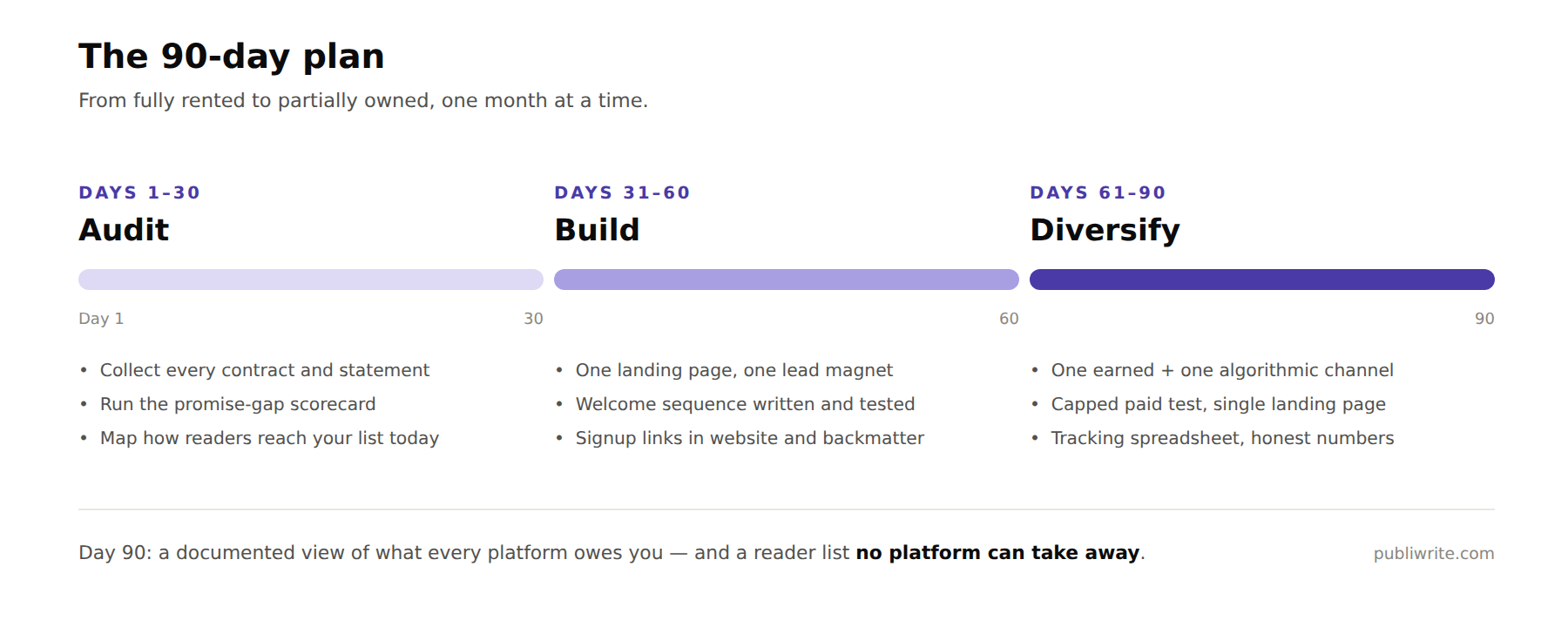
Days 1–30: audit. Gather every agreement, invoice, and royalty statement you have. For each service, write down what you pay, what you get, which rights are involved, and how you'd leave. Run the promise-gap exercise on your two most important providers. Then audit your reader touchpoints: can someone actually join your list from your website? From your backmatter? Do you know where your existing subscribers came from?
Days 31–60: build the owned path. One landing page, one lead magnet, one short welcome sequence. Add the signup link to your site and your latest book's backmatter. Test the whole path yourself: signup to delivery before sending any traffic to it. A broken automation discovered by your first hundred subscribers is an expensive way to learn.
Days 61–90: diversify and measure. Pick one earned channel and one algorithmic channel and work them deliberately - two genre communities you participate in weekly, say, or a consistent short-form video habit pointing at your backmatter link. If you try paid, cap the budget and use a single landing page so you can tell what's working. Set up tracking before you scale anything: tagged links for each channel, and a simple spreadsheet covering cost per subscriber, conversion rate, and earnings per sale after fees. It doesn't need to be sophisticated. It needs to exist, and it needs to be honest.
At the end of ninety days you'll have something most authors never build: a documented view of what every platform actually owes you, and a growing list of readers no platform can take away. Neither one will make a book sell by itself. But the next time a contract, an algorithm, or a "launch acceleration package" changes the rules on you, you'll be negotiating from your own ground - and that changes every conversation that follows.
If you run the scorecard on a service you're currently using or considering, I'd like to hear where the biggest gap showed up - tell us on Discord.
And if you've ever signed something where the promise didn't survive the contract, that story helps other authors more than any checklist.
A last word. We built PubliWrite because we think authors deserve one platform that actually fits how they work - and we'd rather build it with authors than guess. If this article's way of thinking about platforms resonates, come argue with us about it: we've opened a Discord community where the roadmap gets discussed in the open. Bring your promise-gap scores.