How to Publish a Book for Free (And Still Get Paid)

Ask ten people what it costs to publish a book and you'll get two contradictory answers. Half will tell you it's expensive: thousands of pounds for editing, design, printing, and marketing. The other half will tell you that you can publish for free, today, this afternoon if you want to.
The annoying thing is that both are right. And the gap between those two answers is exactly where most first-time authors get lost.
So let's untangle it properly. It is possible to publish a book without spending a penny and earn royalties on every copy sold. But "free" in publishing means something specific and narrower than most people assume, and knowing where the real costs hide is the difference between a smart launch and a disappointing one.
What "publishing for free" actually means
For most of publishing history, there was no free option. You either convinced a traditional publisher to gamble on your manuscript, or you paid a vanity press a small fortune to print boxes of books that usually ended up in your garage. The expensive part was never ambition; it was inventory. Printing a book before anyone had bought it meant somebody had to absorb the risk of it not selling. Usually the author.
Print-on-demand quietly deleted that problem. A book can now be printed after it's ordered - one copy, for one reader, shipped directly. Ebooks went further and removed manufacturing entirely. Once the physical risk disappeared, so did the main reason to charge authors upfront.
Which is why, on every major publishing platform, uploading a manuscript costs nothing. Even IngramSpark, which charged title setup fees for years, dropped them. The platform makes its money on the other side of the transaction: a percentage of each sale, plus the printing cost when a physical copy is ordered.
That's the honest definition of free publishing. Not that publishing has no costs, but that the costs have moved to the point of sale, where they're only ever paid out of money your book has already earned.
How you actually get paid
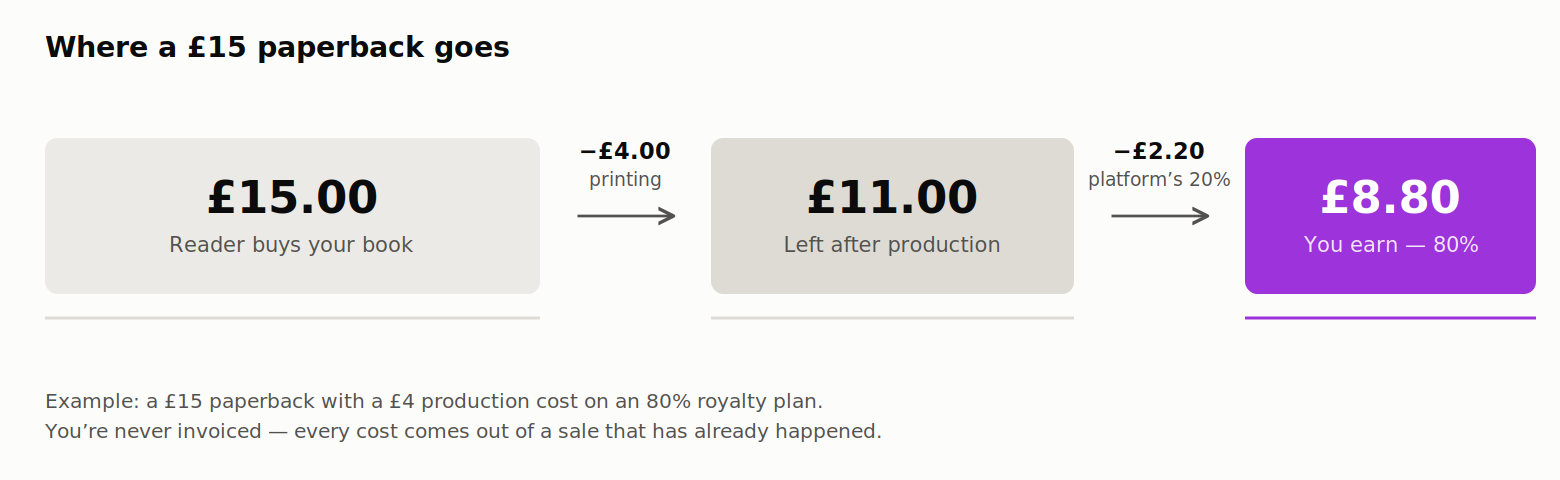
This is where first-time authors get confused, so here's the maths on a real example.
Say your paperback is priced at £15 and costs around £4 to print. When a reader orders a copy, the platform prints it, takes that £4 off the top, keeps its percentage of the sale, and pays you the remainder as a royalty. You were never invoiced for anything. The book funded itself.
Ebooks are simpler still: no print cost, so your royalty comes straight off the sale price minus the retailer's cut. But "the retailer's cut" varies more than most guides admit, so here's roughly how the major platforms compare at the time of writing:
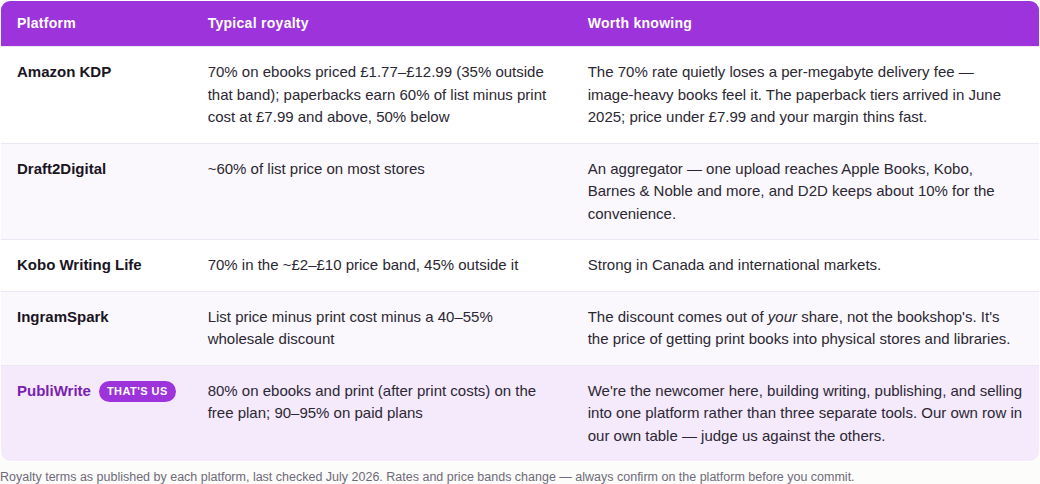
Two caveats. These numbers shift: IngramSpark raised its fees as recently as February 2026 so check the current terms before you commit. And royalty bands, ISBN rules, and tax withholding all vary by country; the UK picture here won't map perfectly onto the US or Australia.
But the sequence is always the same: publish first, get paid when readers buy. Notice what that does to risk. The worst-case scenario for a free-published book isn't debt - it's silence. That's a far better failure mode than a garage full of unsold stock.
What's free, what's sometimes free, and what's worth paying for
Not everything has been swept into the free column, and pretending otherwise is how authors end up with books that look self-published in the bad sense.
The genuinely free things are the mechanical ones: uploading, ebook distribution, print-on-demand setup, royalty collection, sales reporting. If a platform charges you for any of those, walk away - vanity presses didn't disappear, they just got better websites.
The sometimes-free things depend on geography and platform. ISBNs are the classic example: some platforms assign one free, others charge a few pounds for theirs, but if you want to own yours outright in the UK, Nielsen charges around £90 for a single number. Basic formatting tools and cover templates increasingly come bundled at no cost too.
Then there's the category where "free" stops being the right question: editing and covers. And here, "readers notice" is true but useless advice, so let's be specific.
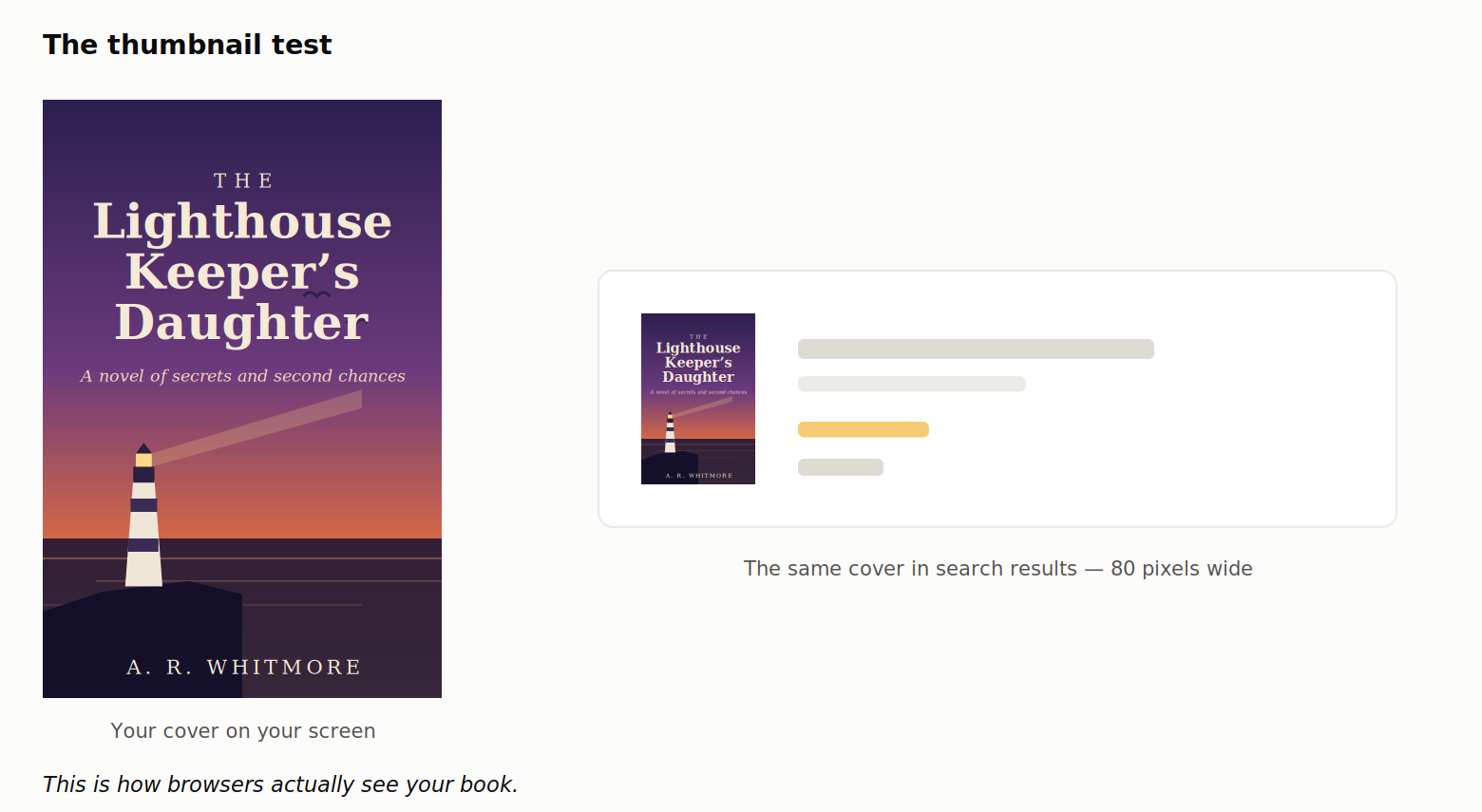
Covers fail at thumbnail size. Your book will be judged as an image roughly the size of a postage stamp in a search results page, competing against fifty others. A cover that looks lovely at full size but turns to mud at 80 pixels wide loses the click every time.
Also, a cover that doesn't signal its genre loses the right clicks. Romance readers expect romance covers. Thriller readers expect thriller covers. A genre-appropriate cover from a specialist designer typically runs £150–£400; pre-made covers from the same designers often go for £30–£80. For genre fiction, this is the single highest-leverage pound you can spend.
Editing problems kill books at predictable moments. Typos in the sample chapters stop the purchase. A saggy middle triggers the did-not-finish. And reviews that mention errors, even three or four of them, quietly poison a book's conversion rate for years. A professional copyedit on an 80,000-word novel typically costs £500–£1,000; a lighter editorial assessment (a professional read with a report, rather than line-by-line correction) runs roughly £300–£600 and is often the better first purchase for a debut author.
One more thing most guides skip: not all books have the same cost profile. A children's picture book without an illustration budget isn't really publishable. A business book can survive a plain cover but not thin content. Genre fiction lives and dies on cover and category placement. Budget for your book, not for "a book."
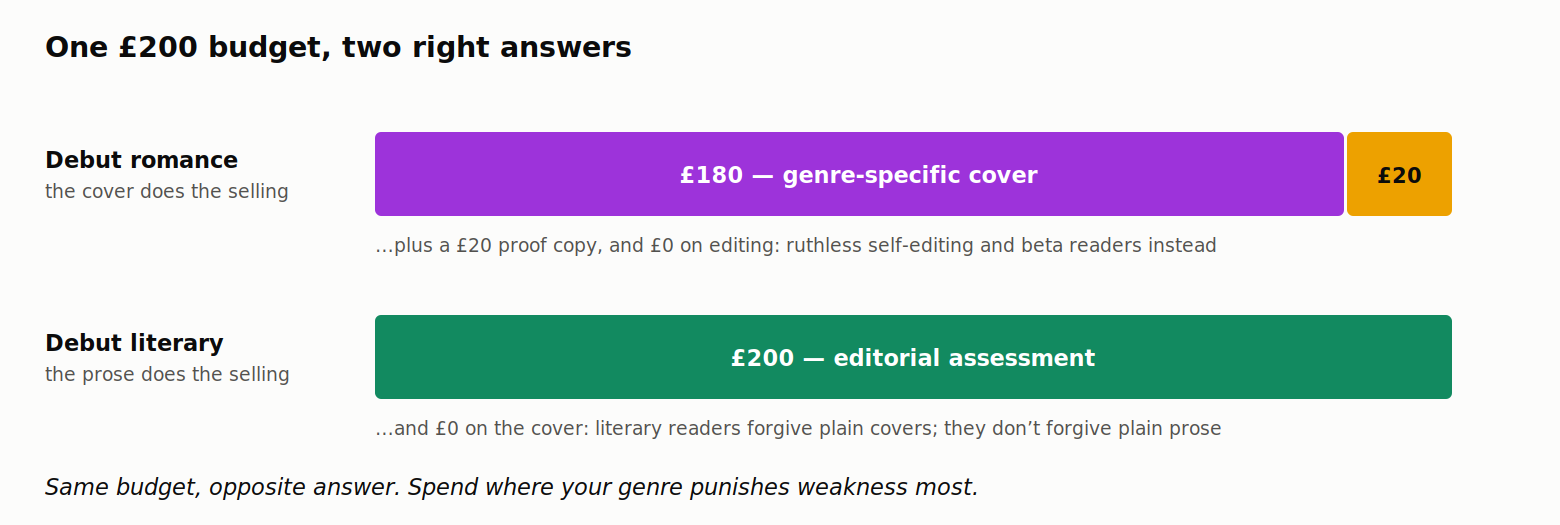
To make that concrete: picture a debut romance author with £200 total. The smart allocation is probably £0 on editing beyond ruthless self-editing and beta readers, £180 on a genre-specific cover, and £20 on a proof copy - because in romance, the cover does the selling and the sample does the convincing. Flip the genre to literary fiction and the same £200 might go entirely on an editorial assessment instead. Same budget, opposite answer.
The cost nobody puts on an invoice
There's one more cost, and it catches people off guard because it never shows up as a payment: time.
Talk to any self-published author about their first launch and you'll hear a version of the same story. The writing was the easy part. Then came formatting for different platforms, figuring out ISBNs, writing the blurb, choosing categories and keywords, and assembling some kind of launch plan. Dozens of hours, sometimes hundreds, and none of it spent on writing.
Publishing today has a low financial barrier and a surprisingly high operational one. The tools are all there, and most of them are free. But you're the one operating all of them. That's not a reason to avoid self-publishing. It is a reason to pick your platform partly on how much of this it takes off your plate, rather than just on the royalty rate.
Free to publish is not free to sell
Here's the part most "publish for free" articles conveniently end before reaching.
Uploading your book is no longer the hard part. Getting anyone to find it is. Millions of titles are published every year, and a book with no reviews, no mailing list behind it, and no category strategy doesn't fail loudly — it just sits there. The barrier in 2026 isn't the gatekeeper. It's the noise.
This doesn't mean you need a marketing budget on day one. It means "free" applies to publication, not to attention. Attention is earned with time (building a reader list, learning your categories, gathering early reviews) or bought with money (ads, promotions) - usually some of both. The free model actually gets stronger as your catalogue grows: each new book costs nothing to publish and advertises the ones before it, which is why so many career indie authors think in series, not single titles.
Go in knowing that, and free publishing is a strategy. Go in not knowing it, and it's a lottery ticket.
So can you really publish completely free?
Yes - with the caveat that "free" buys you publication, not polish or visibility. If your goal is to get your book on sale and earning royalties, you can do that without spending anything, and it's a real book, really for sale. For a first book, that's often exactly the right move: the launch will teach you more than any guide can.
If you take the free route, here's the minimum-viable checklist:
- Self-edit hard, then recruit beta readers. Free, and it catches most of what a copyedit would — if you actually act on the feedback.
- Skip the ISBN for an ebook-only launch — most stores don't require one. For print, use whatever your platform offers (free or a few pounds) rather than buying your own, unless you plan to distribute wide or switch platforms later.
- Spend real hours on the cover brief, even with a free template — study the top 20 covers in your exact subgenre first and copy their visual conventions shamelessly.
- Get your categories and keywords right before launch. A brilliant book in the wrong category is invisible. This costs nothing but an afternoon of research.
- Order one proof copy (a few pounds — the one forgivable expense) and read it on paper before you hit publish. Errors hide on screens.
And if you're building toward a career rather than a single launch, treat free as your foundation, not your ceiling. Put your first pounds into whichever of cover or editing your genre punishes most.
Where PubliWrite fits
Since you're reading this on the PubliWrite blog, here's our version of the model, stated plainly.
Publishing on PubliWrite is free, and that isn't a trial - upload your manuscript, publish, and earn 80% royalties on every sale, indefinitely. If your goal is to get one ebook into the world, the free tier is the whole product. You don't need anything else, and we're not going to pretend you do.
Our subscriptions exist for a different kind of author: the one treating their books as a business. Nearly everything this article says costs time or money when you assemble it piecemeal - ISBNs, formatting, editorial feedback, metadata and discoverability work - is what the paid plans bundle: ISBNs provided by PubliWrite, AI-powered manuscript analysis, smart summaries and context-aware rephrasing, formatting tools, publishing workflows, and discoverability features - plus a higher royalty rate (90–95% instead of 80%) and no limits on how often you publish. They're built to shrink the operational barrier from the middle of this article - the hours, not just the pounds.
The honest way to think about it is the same test you'd apply to any platform: publish free first if you like, and upgrade when the workload tells you to - usually the point where you're managing a growing catalogue rather than launching a single book. Free gets you published. The paid tools are for turning published into a business.
Final thoughts
Publishing a book has never been cheaper. Publishing a book well still takes work - but the nature of the work has changed. The question facing new authors is no longer "can I afford to publish?" It's "where do my limited time and money actually matter?"
Get that answer right and free publishing isn't a compromise. It's simply how publishing works now.
If you've published without spending a penny - or you're planning your first release - tell us how it went in the comments. The details of real launches are worth more than any guide, including this one.