How to Write a Book Blurb That Sells (and Keeps Selling)


Search "how to write a book blurb" and you'll get the same formula a thousand times: open with a hook, raise the stakes, end on a cliffhanger. It might even work for the first sale. But nobody talks about what happens after someone actually reads the book you sold them.
Here's the uncomfortable version: a blurb isn't a pitch. It's a promise. And in marketing psychology, a promise has three parts: you make it, you enable someone to act on it, and then you have to keep it. Most blurb advice stops at part one. That's why "not what I expected" is one of the most common complaints in negative reviews across every genre. Those readers aren't reviewing the prose. They're reviewing the gap between what they were promised and what they got.
If you only optimise for the click, you're optimising for the sale you already have and quietly taxing the one you haven't made yet.
The formula everyone teaches (and where it stops)
First, the basics, because they do matter. A working blurb has three moving parts:
- The hook: who your protagonist is and the situation that makes them interesting, in one or two lines.
- The stakes: what they want, what's in the way, and what it costs them to fail.
- The open question: the unresolved tension that makes a browser need to know what happens.
Aim for 100–150 words for fiction, written in third person present tense, with the genre unmistakable by the second sentence. That's the formula, and there's nothing wrong with it.
The problem is what the formula leaves out. It tells you how to make the promise. It says nothing about whether your book can keep it. The rest of this article is about that second half.
1. Write your blurb before you write your book
This sounds backwards, but plenty of working novelists draft their blurb, or at least a rough back-cover pitch, before they outline. Not as marketing, although it helps with marketing too, but as diagnosis.
If you can't compress the book you want to write into four tight sentences with real stakes, that's rarely a blurb problem. Usually the central conflict hasn't been nailed down yet. A blurb that won't come together is your manuscript telling you something a full outline will hide for another 80,000 words.
Try it early: name your protagonist, their want, what's in the way, and what they stand to lose. If that paragraph feels thin, that's your revision note, not your marketing homework.
Here's what that looks like in practice. Say your first pass reads:
"When Sarah moves to a small coastal town to start over, she discovers the town is hiding dark secrets, which means she'll have to confront her own past to survive."
Read it like a diagnostician and every clause is a placeholder. Start over from what? Which secrets? Whose past? That blurb is vague because those decisions haven't been made yet. And guess what? you were about to write a whole novel on top of them.
Now the version after you've forced the answers:
"Sarah buried the audit that ruined three families. Now the widow of one of them owns the only café in the town Sarah picked to disappear in, and she remembers everything."
Same story, allegedly. But now there's a crime, a debt, an antagonist with a reason, and a collision you can see coming. Notice what happened: writing the blurb didn't just sharpen the pitch. It designed the book.
Keep that paragraph pinned above your desk while you draft. Every scene either feeds the promise it makes or it doesn't, and the ones that don't are your first cut list. Which is the other thing nobody tells you: the blurb you write on day one won't be the one you publish. Its job is to keep you honest until you get there.
2. Mine the one-star reviews of your comp titles
Everyone tells you to read the five-star reviews of books like yours to figure out what readers love. Almost nobody tells you to read the one-star reviews.
Search your genre and comp titles for phrases like "not what I expected", "false advertising", or "nothing like the description". You'll start seeing a pattern specific to your genre. Cosy mysteries get hammered for overselling the twist. Romance blurbs promise a trope that doesn't show up until the epilogue. Psychological thrillers get punished for "gripping" blurbs sitting on slow-burn books.
That pattern is a market-level promise gap: a promise your genre keeps making and keeps breaking. And it hands you your blurb strategy for free.
Say you write psychological suspense and the one-star reviews of your comps keep saying "the twist was obvious" and "this is a domestic drama, not a thriller". Then "a twist you'll never see coming" is the one line you should never write, no matter how well it converts. Sell what your book actually does instead:
"A slow unravelling of a marriage built on one lie. The question is who is lying now."
That line filters out the reader chasing a Gone Girl gut-punch and pulls in the one who wants exactly the book you wrote. You lose a few clicks. You keep your rating. Given that your rating is what earns you every future click, that's not a trade-off. It's the whole strategy of this article in one decision.
3. Run a Promise Audit before you hit publish
Once your blurb is drafted, don't just proofread it. Audit it against the book itself. For every claim or implication in the blurb, find where the manuscript pays it off:
- The stakes named in line one: Do they actually resolve by the climax, or fade out by act two?
- The tone: Does chapter one read the way the blurb sounds? A blurb with dry wit followed by a grim opening chapter is a promise broken on page one.
- Any comp claim ("for fans of X"): Is it genre-honest, or borrowed because the comp title sells well?
Anything that fails the audit gets one of two fixes: cut the line, or change the book. There's no third option where you keep both and hope.
This is the step most authors skip, because it feels like admin after the "real" writing is done. But run the numbers. A promise audit costs you an afternoon. A broken promise costs you a cluster of bad reviews in your first month. And that's exactly when store algorithms are deciding whether your book gets shown to anyone at all. It's the cheapest edit you'll ever make, and the only one that protects every sale after the first.
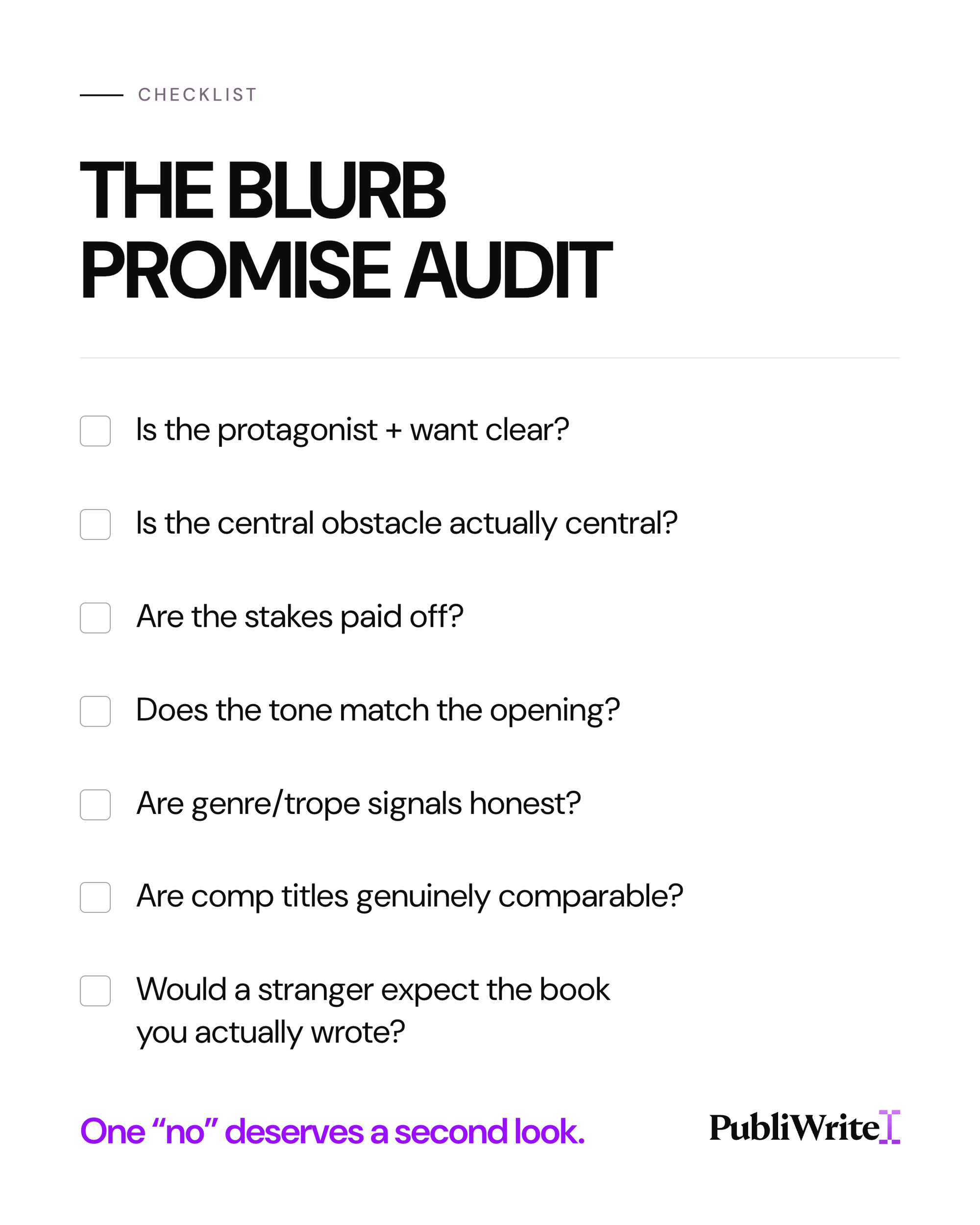
Your Promise Audit checklist
Before you publish, run your blurb through these six questions:
- Could you have written this blurb before the manuscript? protagonist, want, obstacle, cost; all in four tight sentences? If it only works because the reader has read the book, it's a summary, not a promise.
- Have you read the one-star reviews of your comp titles and checked that your blurb doesn't make the exact promise your genre is known for breaking?
- Does every stake named in the blurb get paid off by the climax? and can you name the chapter where it happens?
- Does chapter one sound the way the blurb sounds?
- Is every comp or genre claim honest to what's actually inside?
- If a stranger read only this blurb, would the book they imagine match the book you wrote?
One "no" is not a proofreading note. It's either a line to cut or a book to fix. It's far cheaper to do either now than after the reviews arrive.
You've done the hard part: written a book that keeps its promises. Don't let publishing be the place it falls apart. PubliWrite takes you from manuscript to on-sale: collaborative editor, quick formatting for ebook and print, characters builder, cover studio and a marketplace where readers are already browsing.
https://publiwrite.com