The Future of Publishing in 2026: Why Authors Are Moving Toward All-in-One Platforms


Twenty years ago, an author had a short list of options and a long set of gatekeepers. If a publisher said yes, they handled almost everything that came after the manuscript: editing, design, formatting, distribution, metadata, marketing. The road was narrow, but once you were on it, someone else did the driving.
That world is mostly gone, and good riddance to a lot of it. Authors can now write, edit, format, publish, distribute, and market entirely on their own terms, reaching readers anywhere without an agent's blessing. Self-publishing stopped being the consolation prize and became a real career path.
But the freedom arrived with a bill attached, and most authors didn't see it coming. The cost isn't money, exactly. It's fragmentation.
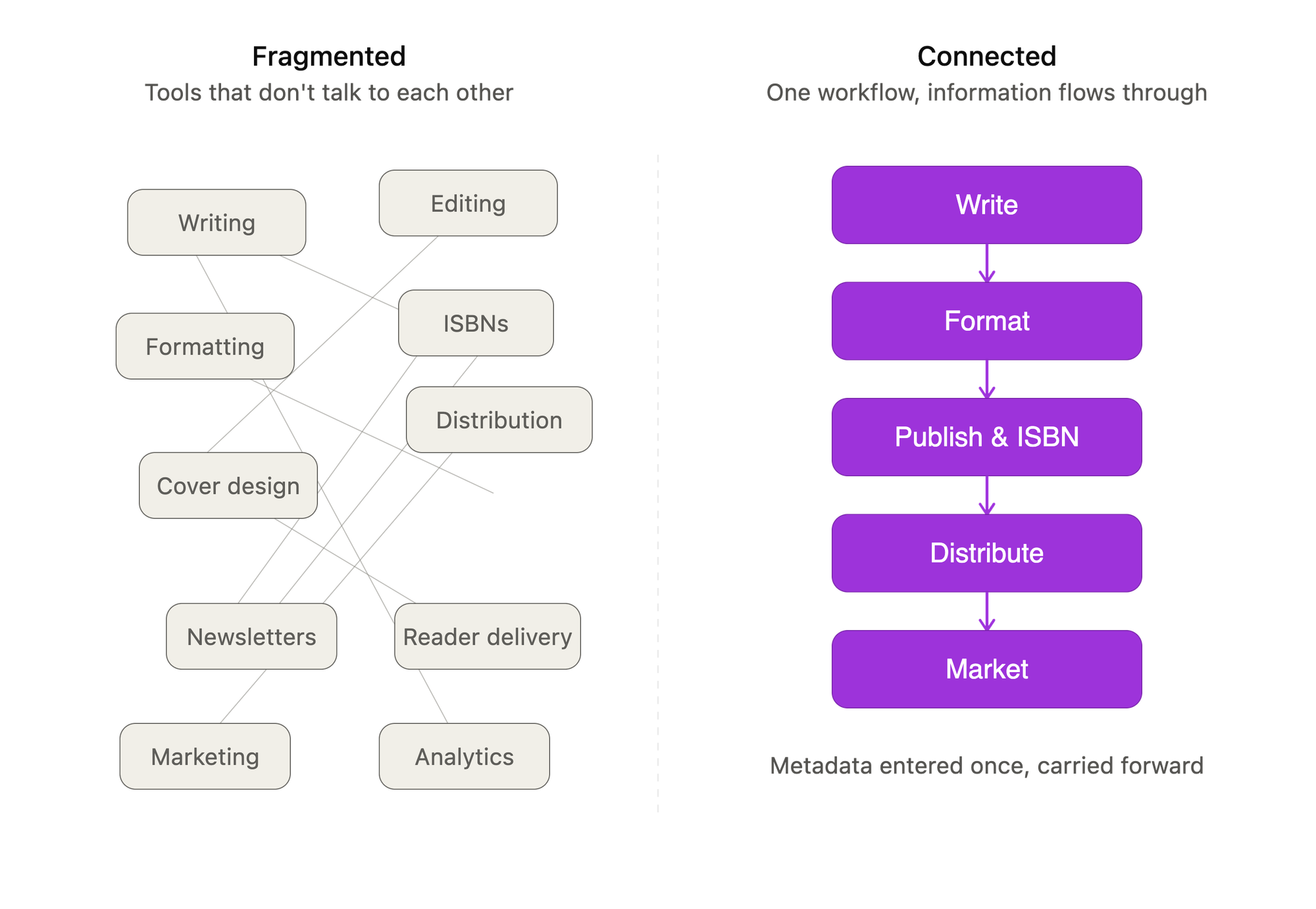
A working author today often runs an entire ecosystem of tools that don't talk to each other. One app for writing, another for editing, another for formatting, another for ISBNs, then a handful more for distribution, newsletters, analytics, and reader engagement. Publishing one book can mean pushing the same information through half a dozen systems, each with its own subscription, its own quirks, and its own learning curve.
For a lot of writers, the hard part is no longer the publishing. It's managing the machinery of publishing.
And there's a new pressure speeding all of this up: AI. It promises to help authors write, analyze, format, and market faster than ever, but it has one stubborn requirement. It only works well when it understands context. The more scattered your workflow, the less these tools can actually do for you.
So a quieter conversation is starting to replace the old one. For years the question was traditional publishing or self-publishing. The more useful question now might be fragmented publishing or connected publishing. Here's how we got here, and why that second divide is the one worth paying attention to.
How the self-publishing stack got so heavy
Choice is the best thing about modern publishing. You pick your editor, your designer, your channels, your strategy. You build a process that fits your goals and your budget exactly. The catch is that nearly every choice adds another tool, and a typical self-published author now juggles something like:
- Word, Google Docs, or Scrivener for writing
- Grammarly or ProWritingAid for editing
- Atticus, Vellum, or InDesign for formatting
- Canva or Adobe for cover design
- Bowker or a national agency for ISBNs
- Amazon KDP and IngramSpark for distribution
- Mailchimp, ConvertKit, or Substack for email
- BookFunnel for reader delivery
- Meta, TikTok, or LinkedIn for marketing
- Yet another dashboard to measure any of it
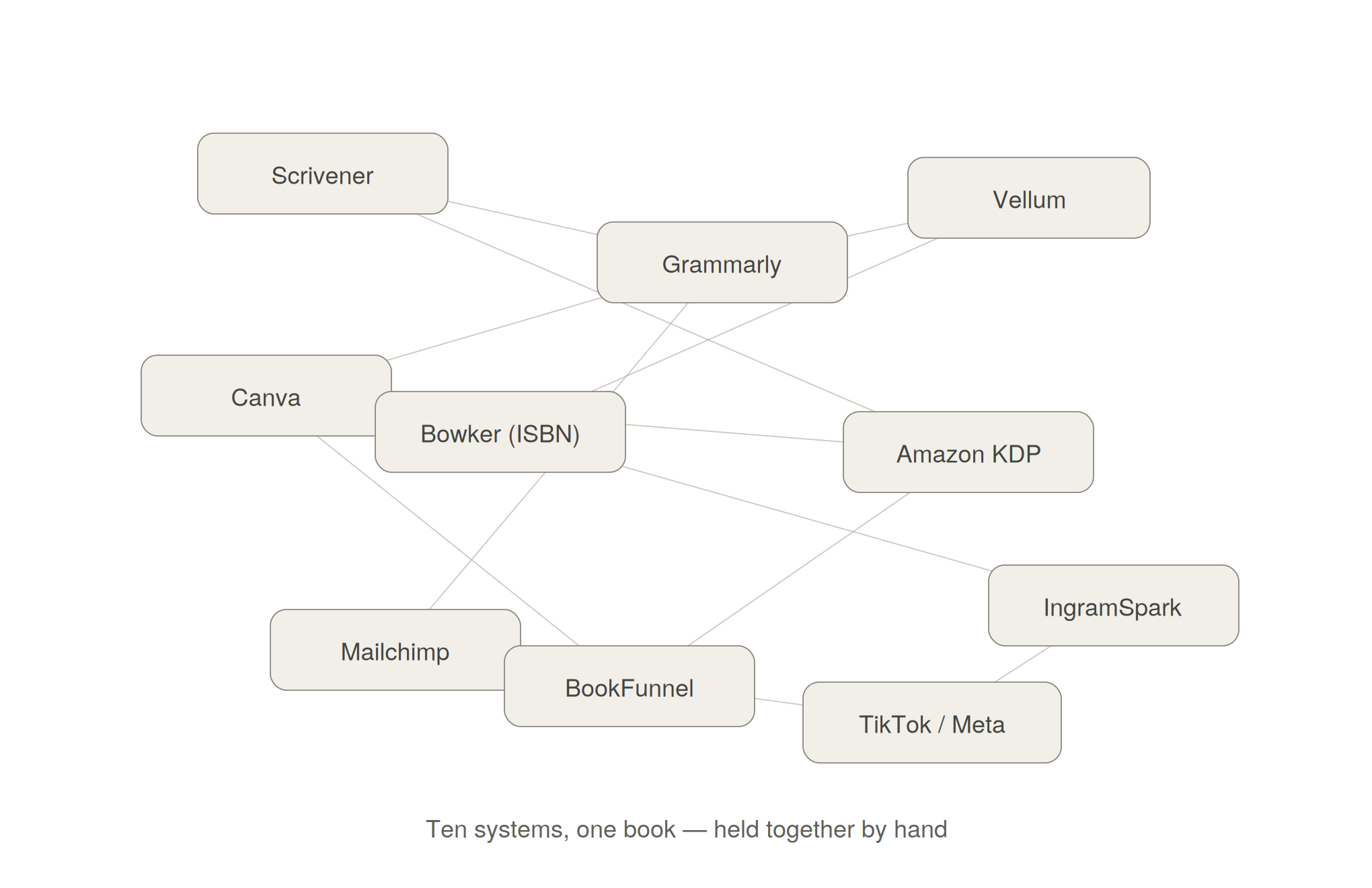
Each one solves a real problem. Together they create a workflow held together with manual labor. Metadata typed during formatting gets retyped during distribution. Author bios live in nine places. Cover files sit in a folder nowhere near the manuscript. A change in one system almost never flows into the next, so you make it again by hand.
The strange part is how it scales. One book across all these platforms is annoying but doable. Five books is a part-time job. Twenty books is infrastructure you now have to maintain, and the maintenance has nothing to do with whether the writing is any good. None of it improves the story. It just keeps the apparatus running.
The original promise of self-publishing was that it removed barriers. It did. But it quietly swapped them for a different kind of barrier: logins, exports, subscriptions, and the steady low-grade tax of keeping ten tools in sync.
Why fragmentation actually costs you
It's tempting to wave this off as the price of independence. But the costs are specific, and they compound.
The first is time. People start self-publishing because they want to write, then find their week filling up with software troubleshooting and file shuffling. The second is money. A stack of "reasonable" subscriptions is still a stack, and the monthly total tends to surprise people once they add it up. The third, and probably the worst, is attention. Every platform is another context switch - another place to log in, another interface to remember, another small decision. Spend enough days bouncing between writing, formatting, distribution, and marketing dashboards and a subtle thing happens: you stop thinking like a writer and start thinking like a project manager.
That's the irony in one sentence. Self-publishing tore down the old walls and replaced them with operational complexity. And that complexity is exactly what the next model set out to fix.
Hybrid publishing got the diagnosis right
If self-publishing answered traditional publishing's limits, hybrid publishing answered self-publishing's. As more writers went independent, a predictable problem showed up. They'd gained control, but they'd also inherited every job a publisher used to do, and not everyone wanted to be their own production department.
Hybrid publishers offered a tempting middle path: professional editing, design, and production without signing away all your rights and royalties the way a traditional deal usually demands. Instead of hiring and herding a half-dozen freelancers, you worked with one outfit that handled the bulk of it. For a lot of authors, that was a genuine relief.
But hybrid reduced the complexity more than it removed it. Manuscripts still tended to live in one place, marketing assets in another, distribution somewhere else again. Communication got better; the underlying workflow stayed split. Cost is the other catch - good hybrid services aren't cheap, which prices out many newer authors, and the quality across the space varies wildly, so writers spend real energy telling the valuable partners from the overpriced packages.
The important thing is what hybrid understood. Authors wanted the ownership of self-publishing without the operational weight of it. What hybrid didn't fully crack was the fragmentation itself. Put simply, hybrid gave authors support; what they're reaching for now is support and seamless flow. Publishing got more supported. It didn't necessarily get more connected - and that gap is where the current shift begins.
Why all-in-one publishing platforms are showing up in 2026
The move toward all-in-one publishing platforms isn't really a software story. It's an expectations story. Authors have watched the rest of their digital lives get connected - calendars that talk to email, banking that talks to budgeting - and publishing still feels like 2012. Write here, format there, distribute in a third place, market in a fourth, measure in a fifth.
That produces a genuine paradox: the industry has never offered more tools, and authors have rarely felt less efficient.
A small example makes it concrete. You finish a manuscript and decide to revise. The revision changes the formatting. The formatting shifts the page count. The page count moves your print cost. The new edition needs updated metadata, and that metadata ripples into distribution and your marketing copy. In a fragmented setup, that's five logins and a long afternoon. In a connected one, it's a single chain of events inside one process.
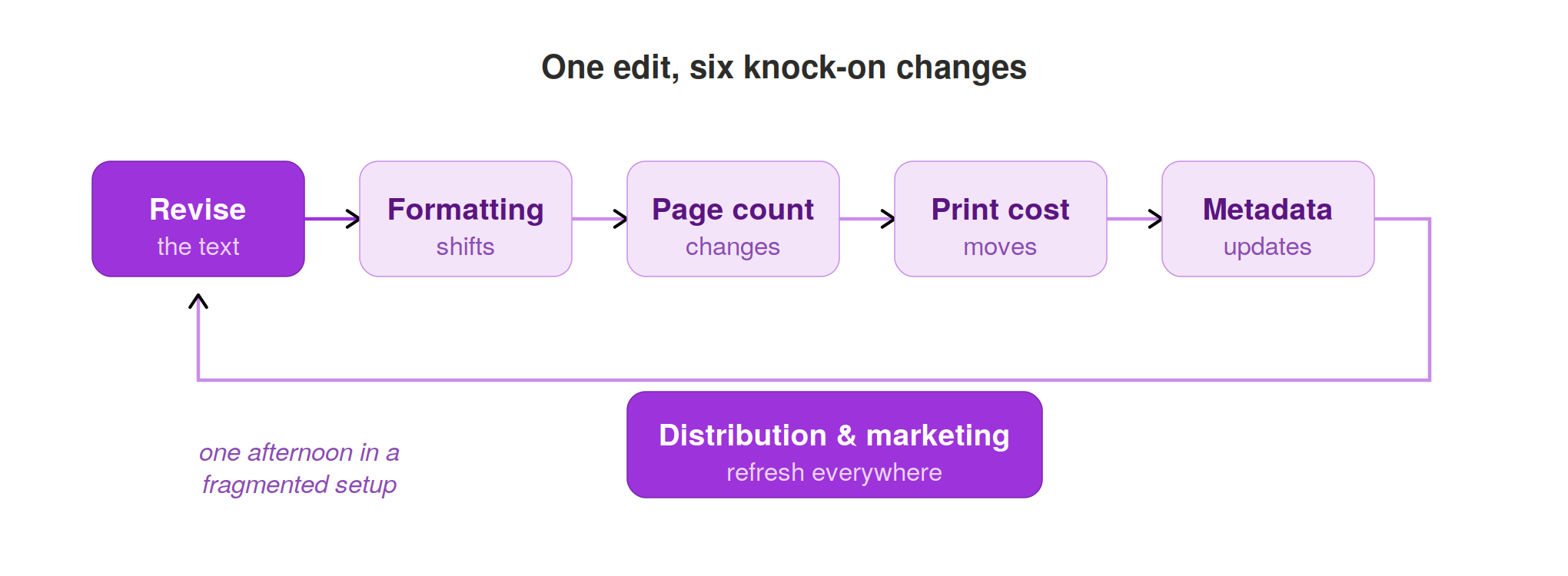
Stretch that across a catalogue, a series, multiple formats, and the occasional translation, and the difference stops being mild. This is the gap all-in-one platforms are trying to close - not by piling on features, but by reconnecting a workflow that drifted apart over a decade. And there's one more force making the case for them, which is the same force making fragmentation harder to live with.
AI is the reason this can't wait
AI didn't start the shift toward connected publishing. It's accelerating it, because AI is far less tolerant of a scattered workflow than people are.
Humans can grit their teeth through a few extra exports and duplicate entries. AI mostly can't make use of what it can't see. A writing assistant that only reads one paragraph is mildly handy. One that understands the whole manuscript is a different tool entirely. A marketing assistant fed only your title writes generic promo copy; one that knows your manuscript, genre, audience, and publishing history writes something a reader might actually respond to.
The pattern repeats everywhere in publishing. Manuscript analysis, formatting help, metadata generation, marketing copy - the quality of each output depends on how much context the system has. And context is precisely what a ten-tool workflow can't provide, because every tool sees only its own slice. The result is fragmented intelligence: a row of assistants making isolated guesses, none of them aware of the bigger picture.
A connected platform changes what's possible. Instead of AI nibbling at individual tasks, it can reason across the whole arc, from draft to discoverability. That's why the more ambitious publishing platforms are investing in AI now - not to bolt on one more feature, but to build something that knows enough to be genuinely useful. The real contest isn't AI versus human creativity. It's connected intelligence versus fragmented intelligence, and authors are quietly choosing the first.
What to look for in a platform this year
If publishing is moving toward connected workflows, the practical question is what to actually look for. The answer is less about features and more about friction. A few things separate the platforms worth your time:
They cut down context switching. The honest test is simple: how much of your workflow happens in one place? Whatever number you land on usually tells you more than any feature list. It's the reason we built Creator Studio to keep writing, formatting, and publishing in a single environment instead of scattering them.
They treat publishing as one process, not a shelf of services. A lot of platforms are really marketplaces of disconnected tools wearing a single logo. The stronger ones treat the whole thing as a continuous flow, which means fewer handoffs and fewer places for errors to creep in. When you revise a manuscript in PubliWrite, the change carries forward instead of forcing you to rebuild the next stage by hand.
They're built for a catalogue, not just a debut. Publishing one title and managing twenty are different problems. Judge a platform by where you want to be in three years - multiple books, formats, collaborators, channels - not just where you are today. That long view shaped how we handle distribution and discoverability, so a growing list doesn't turn into growing overhead.
They use AI with actual context. "Has AI" stopped being a differentiator the moment everyone added it. The question that matters: does the AI understand your manuscript, metadata, and audience, or is it generating from a blank box like everything else? Because everything lives in one place, our AI assistance can draw on the whole project rather than a single fragment.
They give you ownership without the overhead. The appeal of independence was always control. The price was always complexity. The platforms gaining ground are the ones trying to keep the control while shedding the busywork - more command, fewer obstacles.
Where PubliWrite fits
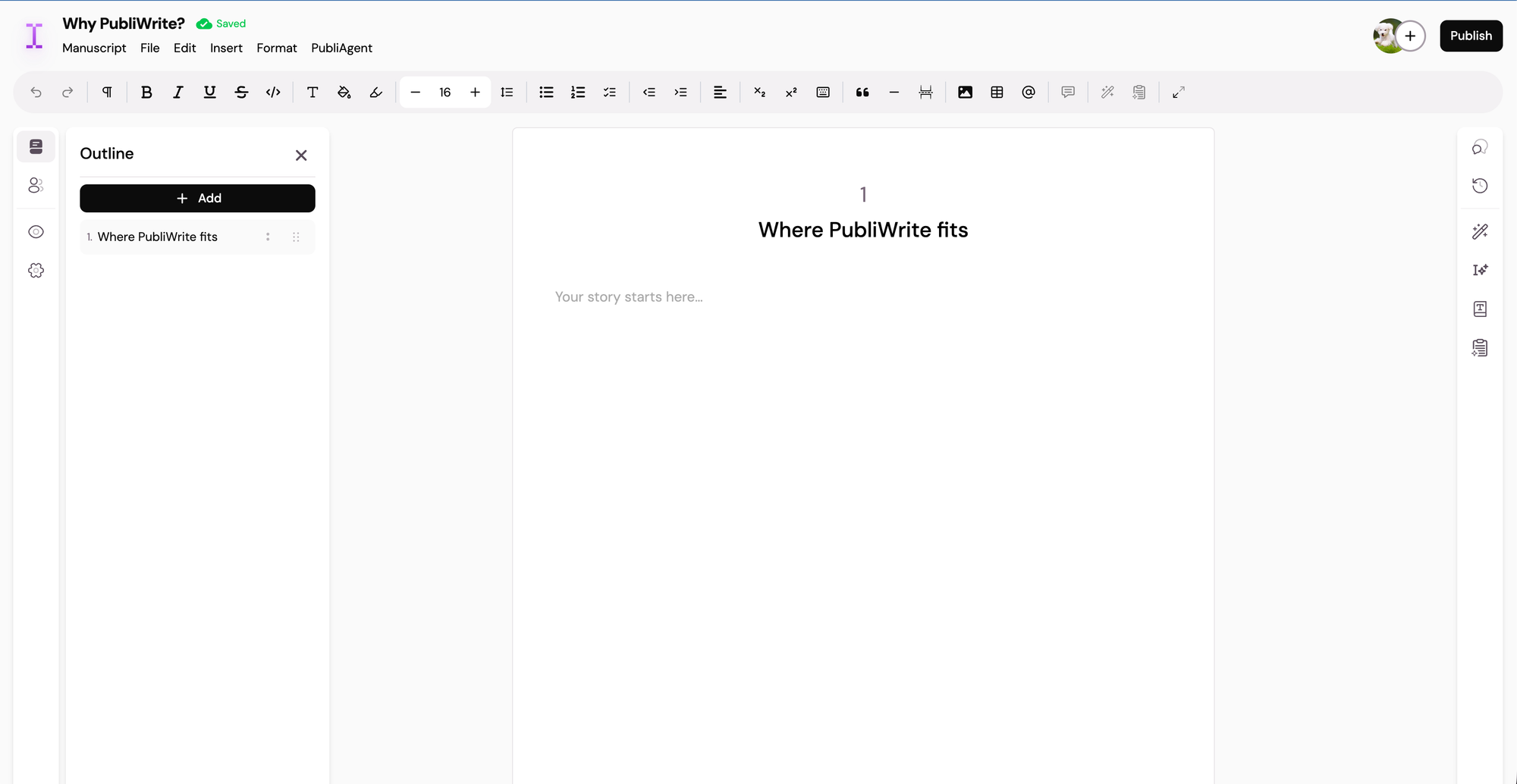
If the last decade of publishing was about freedom, the next one looks like it's about simplification. Authors aren't asking for less control. They're asking for fewer things standing between them and their readers.
That's the problem PubliWrite was built around. Rather than treating writing, formatting, ISBN management, publishing, discoverability, and AI assistance as separate stops handled by separate tools, we connect them into one workflow. Not because every feature has to live under one roof for its own sake, but because publishing simply works better when your information flows from one stage to the next instead of being rebuilt each time. A manuscript shouldn't need reassembling every time it moves forward. Metadata shouldn't be entered five times. And your AI shouldn't lose the plot because it only ever sees a fragment of your work.
That philosophy runs through everything we make, from collaborative writing and formatting to ISBN support, discoverability, and AI-powered analysis. The goal was never more software. It was less friction.
The authors who do well over the next decade probably won't be the ones running the most tools. More likely they'll be the ones running the fewest - not for lack of ambition, but because they've got better systems behind them. The future of publishing may not belong to those who publish differently so much as those who publish more simply.
If that's the direction you're already leaning, you can try a connected workflow free and judge it by the only test that counts - whether it gets out of your way. And while you're here: how many tools does it currently take you to get a single book out the door? Tell us in the comments. We read every one.
👉 How many different tools do you currently use to publish a book?
👉 Do you think publishing is becoming simpler or more complicated?
I’d love to hear your perspective in the comments.