How to Write Better AI Prompts for Book Writing (Without Losing Your Voice)


Last month, an author on our platform told us she'd spent three hours trying to get ChatGPT to rewrite her opening chapter. The result? Four versions that all sounded like the back of a cereal box. "It's useless", she said.
It wasn't. She'd typed "rewrite my first chapter to be more engaging" and expected magic. That's a bit like handing someone your car keys and saying "make it faster" without mentioning the engine's overheating.
The conversation around AI in writing has become exhausting. One camp insists it'll replace authors within five years. The other treats it like creative sacrilege. Neither position is particularly useful.
Here's what we've actually observed, working with thousands of self-publishing authors: AI is a genuinely powerful editorial tool when you know how to direct it, and an impressively mediocre one when you don't. The gap between those two outcomes almost always comes down to a single skill - prompting.
Not "prompt engineering" in the Silicon Valley sense. Just the ability to clearly communicate what you need, what you're writing, who it's for, and what you don't want changed.
That's what this article is about. We'll cover where AI is legitimately useful in the book writing process, where it falls flat, and a practical framework for getting better results from it - without surrendering your voice in the process.
The Biggest Mistake Authors Make with AI

Here's a prompt we see constantly:
"Write me a fantasy chapter"
That's not a prompt. That's a wish. And AI isn't a genie - it's a pattern-matching engine with no idea who you are, what you're writing, or what "good" means to you.
When you type something that vague, the system has no choice but to default to the statistical average of everything it's trained on. You get perfectly grammatical, structurally sound prose that reads like it was assembled by committee. Because, in a sense, it was.
The frustration is understandable. You paste in a paragraph you've been wrestling with, type "make this better", and get back something that's technically cleaner but has lost everything that made it yours. The dry humour is gone. The rhythm you'd spent an hour on has been smoothed into something generic. So you close the tab and conclude that AI can't write.
But the tool didn't fail you. The instructions did.
AI has no access to your genre, your audience, your tonal preferences, or the emotional beat you're trying to hit in that scene. When you don't supply those things, it fills the gap with the safest possible guess - and safe writing is almost always forgettable writing.
Think of it less like collaborating with another writer and more like briefing a very fast, very literal assistant who has read millions of books but has no taste of their own. If you tell that assistant "tighten the pacing in this paragraph, cut the passive voice, and keep the sarcastic undertone," you'll get something genuinely useful. If you say "make it better," you'll get beige.
The quality of AI output is, almost without exception, a mirror of the quality of the input. That's not a defence of the technology - it's just how it works. And once you accept that, you can start getting real value from it.
What AI Is Actually Good For in Book Writing
AI becomes powerful when it’s used for analysis, refinement, and structure - not authorship. It’s not a replacement for imagination. But it can be an extremely efficient assistant.
Here’s where AI genuinely shines in the writing process:
Word & Style Analysis
One of the hardest things for writers is seeing their own patterns.
AI can quickly identify:
- Repetitive words or phrases
- Overuse of adverbs
- Passive voice patterns
- Sentence length monotony
- Dialogue-heavy vs description-heavy sections
Instead of manually scanning 80,000 words, you can ask for structured analysis and receive actionable feedback in seconds.
This doesn’t change your voice. It helps you refine it.
Summaries & Structural Clarity
If you wrote a chapter 3 months ago chances are you won't exactly remember what's in it. AI is particularly strong at summarisation.
You can use it to:
- Generate chapter summaries
- Test whether your plot progression makes sense
- Identify pacing inconsistencies
- Spot missing transitions
- Outline key themes
Sometimes reading a concise summary of your own chapter reveals structural gaps you couldn’t see while immersed in the prose. It’s like stepping back without emotionally detaching.
Rephrasing & Clarity Improvements
Writers often know when something feels "off" - but struggle to articulate why.
AI can:
- Suggest alternative sentence constructions
- Simplify overly complex phrasing
- Tighten wordy paragraphs
- Offer multiple variations of the same sentence
The key is this:
You don’t accept everything it gives you.
You compare, choose, refine.
It’s a brainstorming partner, not a ghostwriter.
Grammar & Technical Corrections
AI is very effective for surface-level editing:
- Grammar fixes
- Punctuation
- Sentence clarity
- Consistency checks
It won’t replace a professional editor for developmental work, but it can clean a draft before it reaches one, saving time and cost.
Identifying Gaps & Inconsistencies
With the right prompt, AI can help you detect:
- Plot holes
- Character inconsistencies
- Timeline contradictions
- Unresolved threads
For example:
“Analyse this chapter and identify any logical inconsistencies in the protagonist’s motivation.”
That’s not writing for you. That’s strengthening your structure.
Formatting & Preparation
AI can assist with:
- Cleaning formatting inconsistencies
- Standardising headings
- Preparing manuscript structure
- Converting rough drafts into cleaner layouts
Especially in self-publishing, this can reduce friction significantly.
The common thread?
AI performs best when it is:
- Analytical
- Structural
- Technical
- Supportive
It performs worst when it’s asked to:
- Invent deep emotional nuance
- Replace your lived experience
- Generate entire novels with no guidance
The 5-Part Prompt Formula for Authors
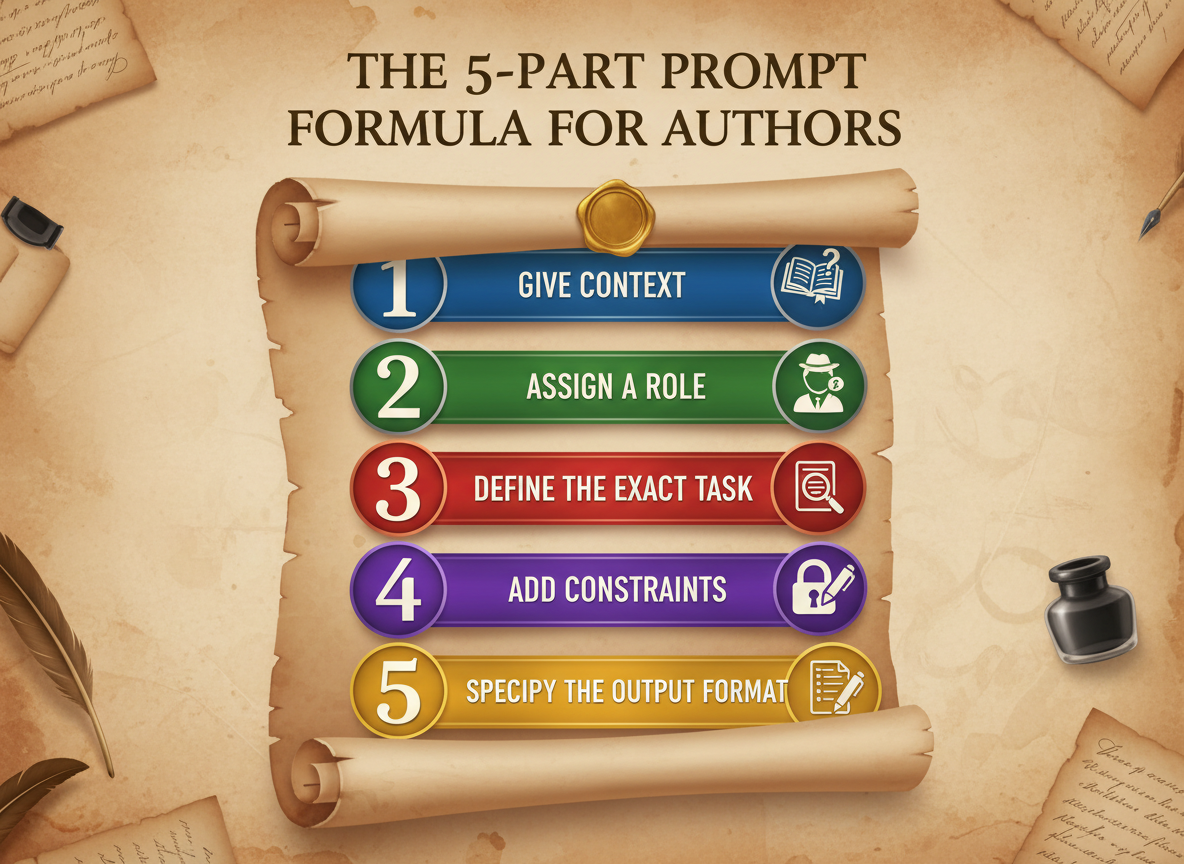
If AI feels inconsistent, it’s usually because the prompt is incomplete. Strong prompts aren’t long - they’re structured. Here’s a simple framework authors can use to get dramatically better results:
1) Give Context
AI doesn’t know your book unless you tell it. Instead of:
“Improve this paragraph”
Try:
“This is from a slow-burn romantic thriller set in London. The tone is dark and restrained”
Genre, mood, audience, and intent change everything. Context prevents generic output.
2) Assign a Role
Tell the AI who it should act as. For example:
- "Act as a professional fiction editor"
- "Act as a developmental editor focused on pacing"
- "Act as a line editor specialising in literary prose"
- "Act as a beta reader giving honest feedback"
When you assign a role, the output becomes more focused and purposeful.
3) Define the Exact Task
Avoid vague instructions like "make it better"
Instead, be precise:
- "Tighten this paragraph and reduce unnecessary adjectives"
- "Rewrite this dialogue to sound more natural and less expositional"
- "Identify pacing issues in this chapter"
- "Summarise this scene in 5 bullet points"
Clarity improves quality instantly.
4) Add Constraints
Constraints protect your voice.
For example:
- "Do not change the core meaning"
- "Keep the tone sarcastic and dry"
- "Maintain sentence length under 20 words"
- "Do not simplify the vocabulary"
Without constraints, AI may overwrite your style.
With constraints, it supports your intent.
5) Specify the Output Format
This is often overlooked. If you don’t specify format, you’ll get messy responses. Instead, say:
- "Provide the answer in bullet points"
- "Give 3 alternative versions"
- "Highlight suggested changes in bold"
- "Return a side-by-side comparison"
This makes the output usable immediately.
Example: Weak Prompt vs Strong Prompt
Weak:
“Rewrite this paragraph”
Stronger:
“Act as a professional fiction editor. Rewrite the following paragraph to improve pacing and reduce passive voice while preserving the original tone. Keep the sentence structure varied and maintain the emotional tension. Provide two alternative versions”
Same text.
Completely different results.
The Real Secret
AI doesn’t weaken your voice. Unstructured prompting does.
When you:
- Provide context
- Define the role
- Specify the task
- Add constraints
- Control the format
You turn AI into a precision tool rather than a content generator. And that’s the difference between authors who feel threatened by AI - and those who feel empowered by it.
What AI Is Not Good At (And Where You Should Be Careful)
For all its strengths, AI has clear limitations. Understanding them is what separates responsible use from over-reliance.
AI is powerful - but it is not conscious.
It does not feel.
It does not experience.
It does not create from lived memory.
And that matters.
1) Deep Emotional Authenticity
AI can mimic emotional language. It cannot replicate genuine emotional experience.
It can describe grief.
It cannot feel grief.
The subtlety of trauma, longing, cultural nuance, humour rooted in personal history - these come from lived experience. When authors rely on AI to generate emotionally heavy scenes without guidance, the writing often feels polished but hollow. And readers can sense that difference.
2) Original Worldviews
AI generates text based on patterns it has seen before. That means it tends toward:
- Familiar tropes
- Safe structures
- Conventional plot arcs
- Predictable phrasing
If you ask it to "write a fantasy chapter", you’ll likely get something that feels like every other fantasy chapter. Originality still belongs to the author.
AI can refine your ideas - but it won’t invent a new worldview for you.
3) Long-Form Narrative Consistency
AI is strong in short bursts. It struggles with:
- Maintaining character arcs across 80,000 words
- Tracking subtle motivations across chapters
- Sustaining complex thematic threads
It can analyse sections - but it cannot independently hold the emotional architecture of a full novel without structured guidance. That architecture is your responsibility.
4) Ethical & Creative Over-reliance
There’s also a practical risk - If authors outsource too much thinking to AI, they risk weakening their own creative muscles.
Writing is a craft.
Prompting is a tool.
One should support the other - not replace it.
AI works best when it:
- Enhances clarity
- Improves efficiency
- Provides analytical feedback
- Offers alternative phrasing
It works worst when it becomes the primary creative engine.
The Balanced Perspective
The goal isn’t to avoid AI. And it’s not to depend on it blindly - It’s to use it deliberately.
Think of AI like:
- Spellcheck in the early 2000s
- Grammarly in the 2010s
- Formatting software in the 2020s
At first, it felt optional.
Eventually, it became standard.
But none of those tools replaced writers - They supported them.
The same applies here.
PubliWrite’s Perspective - AI as Support, Not Substitution
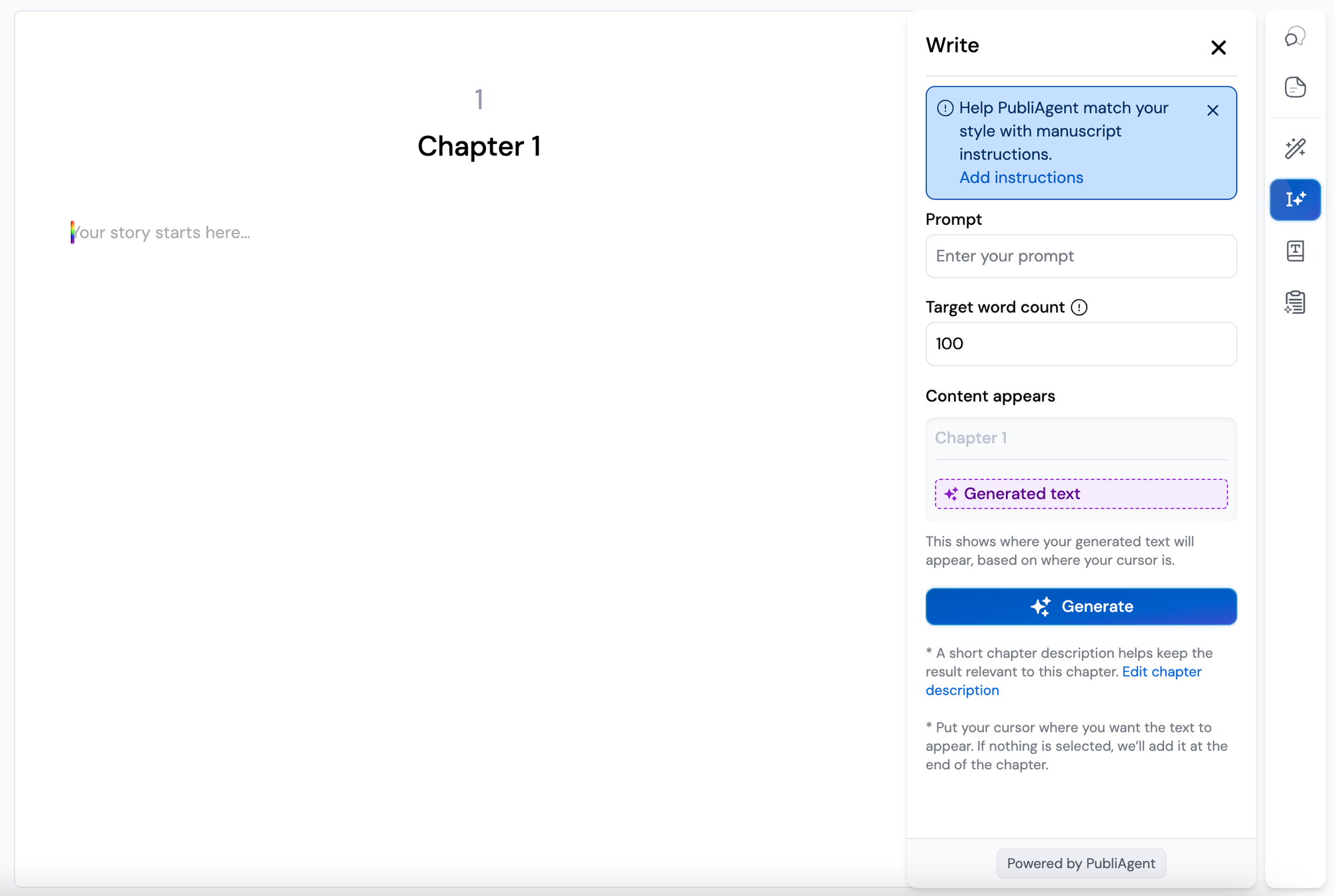
At PubliWrite, we don’t see AI as a replacement for authors. We see it as infrastructure.
The publishing industry is evolving quickly. Manuscript screening, metadata optimisation, market trend analysis - AI is already embedded in the backend of publishing. The real question isn’t whether AI exists. It’s whether authors are given tools that use it responsibly and transparently.
Our approach is simple:
AI should strengthen your writing - not override it. Here’s how we’re integrating AI into the writing process:
Word Analysis
Authors can analyse their manuscript to identify repetition, sentence-length patterns, passive voice usage, and stylistic inconsistencies. Instead of guessing where your writing feels uneven, you get structured insights.
Smart Summaries
Generate clean, structured summaries of chapters or full sections. Useful for blurbs, query letters, structural overviews, and pacing analysis.
Context-Aware Rephrasing
Rather than rewriting your content from scratch, our tools suggest alternative phrasing while preserving tone and intent. You stay in control - AI offers options.
Tone Control
Every author has a distinct voice. Whether your writing is lyrical, minimalistic, sarcastic, academic, or emotionally intense, you can guide the AI to respect that tone. Instead of flattening your style, the system adapts to your direction, ensuring suggestions align with your creative identity.
The goal isn’t automation. It’s clarity. AI should remove friction from the technical side of writing so authors can focus on the creative side. Because the future of publishing won’t belong to those who reject AI entirely - nor to those who let it write for them.
It will belong to authors who know how to guide it.
Final Thoughts - The Author Is Still in Charge
Here's what nobody in the AI debate seems willing to say plainly: the technology is not that interesting. What's interesting is what writers do with it.
AI didn't change the craft of writing. It changed the workflow around it. The part where you spend forty minutes hunting for a word you've used eleven times. The part where you squint at a paragraph wondering if the tense shifted somewhere around the third clause. The part where you reformat your manuscript for the sixth time because the chapter headings won't behave.
That stuff used to eat hours. Now it doesn't have to.
The actual writing, the part where you sit with a character long enough to understand why they'd lie to someone they love, or where you find the one sentence that makes a reader stop and reread it, that hasn't changed at all. AI can't do that. It's not even close to doing that. And if the discourse around it has made you feel like your craft is under threat, the discourse is wrong.
What has changed is that there's now a skill gap between authors who know how to direct these tools and those who don't. Not a talent gap. A skill gap. The author who understands how to ask for a structural analysis of their pacing will get more from thirty minutes with AI than someone who types "make this better" and walks away disappointed. That's not about creativity. It's about communication.
The writers who'll get the most out of the next decade of publishing won't be the ones who adopt AI fastest or reject it loudest. They'll be the ones who figured out where it's useful, where it isn't, and how to keep their own instincts in the driver's seat.
Your voice isn't something an algorithm can generate. It's the accumulation of every book you've read, every conversation you've had, every draft you've thrown away. No prompt produces that.
So use the tools. Or don't. But either way, write the book only you can write.
👉 Are you using AI in your writing process yet?
👉 And if so, do you feel it strengthens your voice — or challenges it?
Before you go:️️
- Follow us: X | LinkedIn | Instagram | Meta
- Visit our website at https://publiwrite.com