AI Content Generation for Authors: What It’s Good For (and What It’s Not)


Few topics in publishing right now trigger stronger reactions than artificial intelligence and most of the arguments, on both sides, are about the wrong thing.
The debate tends to orbit one question: can AI write a book? It's a reasonable thing to wonder, and the answer is technically yes, in the same way a blender can technically make soup. What comes out is recognisable, occasionally fine, and somehow deeply unsatisfying.
But that's not where AI is actually changing things for authors.
The part of publishing nobody talks about enough is everything that happens around the manuscript. A book doesn't just exist, it has to be introduced, summarised, pitched, announced, explained, and then explained again in slightly different language for a slightly different audience. There are blurbs and bios, newsletter copy and social posts, reader guides and launch emails. For many writers, producing all of that is nearly as exhausting as writing the book itself and it gets far less romantic attention.
This is where AI becomes genuinely useful. Not as a ghostwriter. As the thing that handles the surrounding noise so the actual writing gets more of your attention.
Used well, AI can generate first drafts of marketing copy, surface structural patterns in a manuscript, suggest rephrasing in a different register, and compress long-form content into summaries without losing the thread. Used carelessly, it produces text that sounds like everyone and no one: competent, smooth, and completely forgettable.
The difference isn't really about the technology. It's about whether the author stays in the room.
In this piece, we'll look at where AI content generation actually earns its place in a writing workflow, where it still falls flat, and how to use it without letting it sand down the thing readers actually come for: the specific way you see things and say them.
The Content Ecosystem Around a Book
Here's something that doesn't get said enough: finishing the manuscript is roughly the halfway point of the writing work.
Around every finished book sits a sprawling amount of supporting material - content that exists not to tell the story, but to explain it, sell it, and keep reintroducing it to people who haven't found it yet. Some of this comes before publication. Some arrives at launch. A surprising amount of it continues long after most authors have mentally moved on to the next project.
Consider what a single book actually requires.
Before publication: a summary tight enough to fit a query letter, a pitch that captures the book in the time it takes someone to lose interest, an author bio that manages to sound both credible and human, early promotional copy that somehow conveys what the book feels like before anyone's read it.
At launch, the list doubles. Back-cover blurb. Retailer descriptions. Newsletter announcements. Social posts in three different lengths for three different platforms. Launch emails. Press summaries for people who will skim them.
After publication, it keeps going - reader discussion guides, pull quotes, alternate blurbs calibrated for different audiences, interview answers covering the same territory in fresh language, promotional copy for events and podcasts the author hopes to land.
None of this is the book. But all of it is what gets the book read.
For independent authors especially, this surrounding work becomes a second job with its own demands, each piece requiring a slightly different register, a different level of detail, a different assumption about who's reading and why. You end up telling the same story dozens of times, in dozens of different containers.
That's precisely where AI earns its place.
Not by doing the thinking, the thinking is still yours, but by handling the repetitive transformations that the manuscript goes through on its way into the world. Summarising. Compressing. Reframing for a different audience. Expanding a blurb into a description, or collapsing a chapter into a quote. Mechanical work that still needs to be done, but doesn't necessarily need to be done by hand every time.
The most honest way to describe it: AI is rarely useful at the center of the book. It's often very useful at the edges: in the space between what you wrote and what the world needs to hear about it.
Where AI Content Generation Actually Helps Authors

Once you start thinking about publishing as an ecosystem rather than just a manuscript, the question changes. It's no longer "can AI write?" It's "where does AI actually reduce friction without reducing quality?"
The answer, in practice, tends to cluster around three things: analysis, transformation, and supporting content. None of them touch the creative core. All of them address the work that surrounds it.
Summaries and Structural Clarity
Long-form writing has a strange effect on perspective: the longer you spend inside a manuscript, the harder it becomes to see it from the outside. AI is particularly good at forcing that outside view.
Ask it to summarise a chapter and you'll often discover things a careful reread wouldn't catch: the scene that seemed essential turns out to carry one idea, a structural gap that felt invisible at 80,000 words becomes obvious in eight sentences, a theme you thought ran through the whole book appears only in the first and last act. The summary isn't better than the chapter. But it's a different kind of lens, and sometimes that's what's missing.
Rephrasing and Style Variation
Every writer knows the specific frustration of a sentence that's wrong but won't reveal why. You've read it forty times. You still can't fix it. AI is useful here not because it writes better than you, but because it writes differently. And sometimes a worse version of a sentence is enough to show you what the right one should look like.
The same applies to register and tone. A passage written for literary readers might need translating for a general audience, or vice versa. AI can run that translation quickly, producing a draft the author then pulls apart and rebuilds in their own voice.
Manuscript Analysis
With the right prompts, AI can function as a fast diagnostic tool surfacing patterns that would take hours to find manually. Repeated phrases. Passive voice clustering in specific chapters. Scenes that are consistently over-described or under-explained. Sections where dialogue carries everything and the physical world disappears.
This isn't editing. It's more like getting a second pair of eyes that never gets tired and has no feelings about your work. What you do with the findings is still entirely up to you.
Marketing and Supporting Content
This is probably where AI earns its keep most reliably. The surrounding material a book requires: blurbs, retailer descriptions, newsletter copy, social posts, reader discussion questions, author bios in three different lengths - is genuinely exhausting to produce from scratch, especially when you've just finished writing 90,000 words and the thought of describing the book one more time feels unbearable.
AI can generate workable first drafts of all of it. Not final drafts — the voice will be flatter, the phrasing safer, the instincts blunter than yours. But a draft you refine is significantly easier than a blank page you fill, and for this kind of repetitive, format-driven content, that head start is worth something.
The Pattern
Across all of these uses, the logic is consistent: AI is useful when the task is analytical, transformational, or adaptive. It's far less useful - and often actively counterproductive - when the task requires genuine creative judgment.
That distinction matters more than it might seem, especially when you look at the growing industry built around AI-generated books. Because that's a different project entirely and it's solving a problem most authors aren't actually trying to solve.
The Rise of "AI-Written Books"
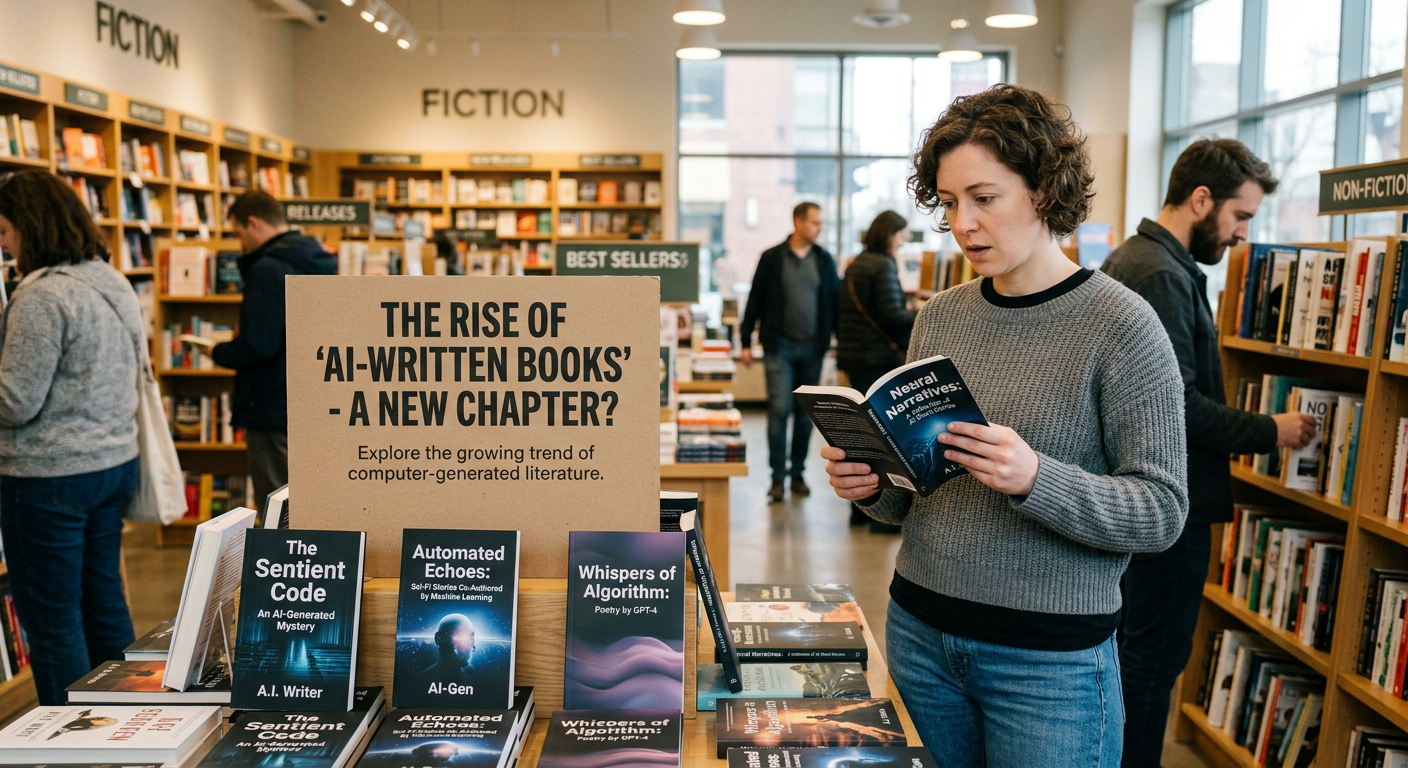
At some point in the last few years, the logical endpoint of "AI can help with content" became "AI can just produce the content". There are now services built entirely around this premise. You provide a topic, the tool generates a manuscript, and somewhere between forty-five minutes and a few hours later, you have a book.
For a narrow category of publishing, this is arguably fine. Informational guides designed to rank in search results, high-volume nonfiction built around a specific keyword, digital products where the goal is coverage rather than craft - in those contexts, speed and scale are the actual product, and AI delivers them. Nobody is pretending otherwise.
But that's a specific business. It's not really writing, in the sense most authors mean when they use the word.
The problem with fully AI-generated manuscripts isn't that they're structurally broken; they're often not. The problem is harder to name and easier to feel. You read a page and nothing catches. The sentences do what sentences are supposed to do. The argument progresses. The information arrives. And yet nothing sticks, nothing surprises, nothing makes you want to read the next paragraph for any reason except completion. It's text that has been produced rather than written, and readers, even ones who couldn't explain why, tend to notice.
What's missing isn't competence. It's the residue of a particular person thinking something through. The slight digression that turns out to be the point. The analogy that only makes sense given where this author grew up or what they care about. The sentence that lands because it's the sentence only this writer would write. That's not a romantic notion of authorship; it's the actual mechanism by which readers form attachments to books and the people who wrote them.
AI, generating without meaningful human direction, produces the shape of a manuscript without that residue. Coherent, interchangeable, and forgettable in a way that's difficult to fix after the fact.
Which is why the more interesting question isn't whether AI can write a book. It's whether that's even the right job for it.
For most authors, it isn't. The real opportunity is narrower and more practical: using AI to sharpen the work around the manuscript, not to replace the manuscript itself. That's a meaningful distinction and understanding it is roughly the difference between a tool that serves your writing and one that quietly substitutes for it.
In the next section, we'll look at where AI still genuinely struggles, and why those limits matter for anyone who wants their work to remain recognisably theirs.
Where AI Still Falls Short
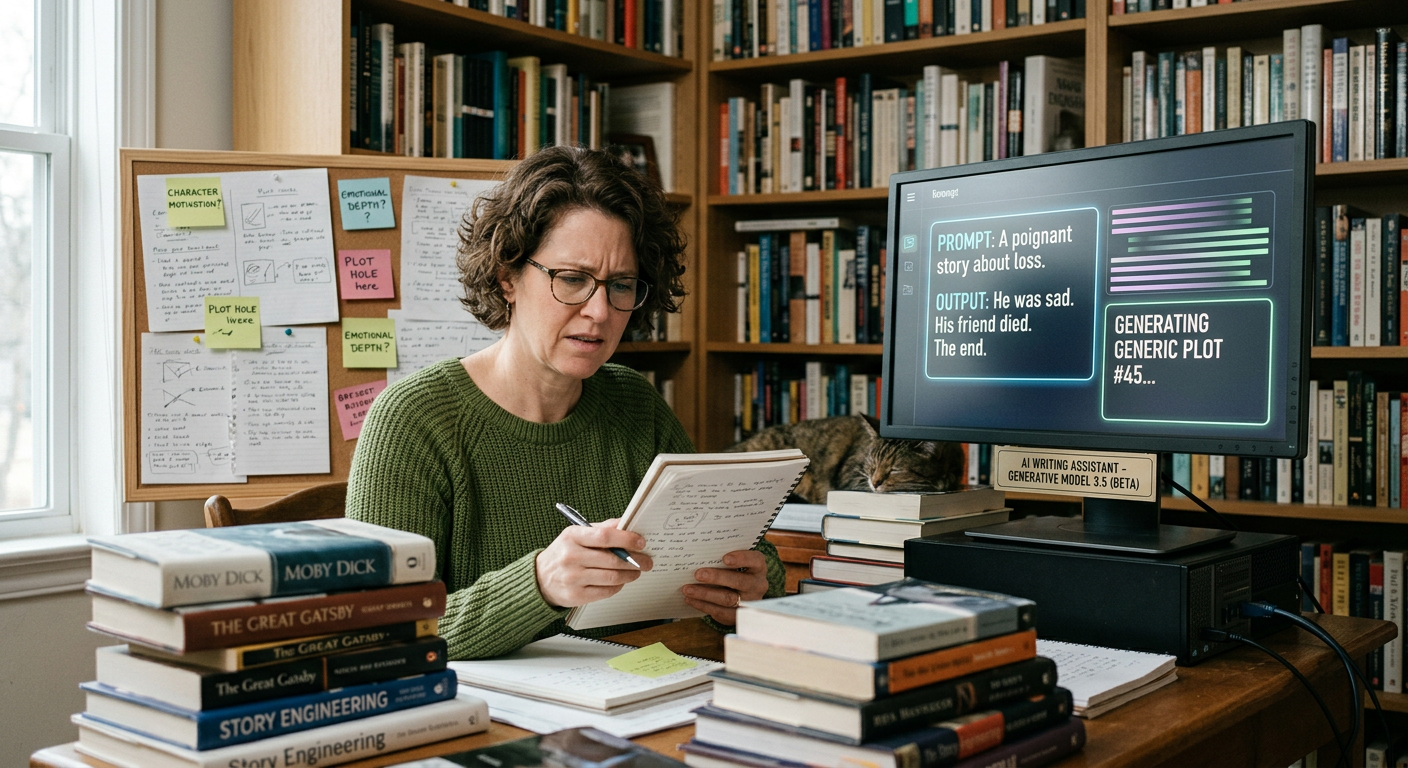
Speed and flexibility are real. So are the limits. And for authors specifically, the limits tend to cluster around exactly the things that make a book worth reading.
Original Insight
AI is trained on what already exists - which means it's very good at recognising patterns and considerably less good at departing from them. It can tell you what a book on this subject usually sounds like. It cannot tell you what only you would notice about it.
The books that stay with readers tend to contain at least one idea, observation, or angle that feels genuinely unexpected - something that arrived because a particular person, with a particular history, looked at a subject from a direction nobody else had tried. That's not a process you can prompt your way into. It requires the kind of thinking that comes from having actually lived something, or spent years caring about something, or being willing to follow a strange instinct far enough to see where it leads.
Emotional Authenticity
AI can write grief. It knows the vocabulary, the rhythms, the kinds of images that typically appear in scenes involving loss. What it doesn't have is any experience of the thing itself which means the output often lands in a strange middle register. Technically appropriate. Strangely weightless.
Readers feel this faster than they can articulate it. Emotional truth isn't a style choice; it's what happens when a writer has actually reckoned with something and the writing carries the evidence of that reckoning. There's no shortcut that produces the same result.
Long-Form Narrative Consistency
Short passages are where AI performs best, which is also where the limitations are easiest to miss. Extend the task to a full manuscript and different problems emerge: threads dropped without resolution, character details that contradict earlier scenes, pacing that flattens in the middle because nothing is building toward anything in particular. The longer the text, the more the absence of genuine narrative judgment starts to show.
Holding a 90,000-word story together requires keeping track not just of what has happened, but of what the reader is feeling at each point and what they need to happen next. That's not pattern recognition. It's something closer to architectural thinking, and it's still largely beyond what current AI handles well unsupervised.
Voice
This is the one that matters most, and the one that's hardest to recover once it's gone.
Voice isn't just style; it's the accumulated evidence of how a specific person thinks. The rhythm of their sentences, the comparisons they reach for, the things they find worth noticing, the moments they linger and the moments they move on. It's what makes a paragraph identifiable even without a byline. AI defaults to a register that's clean, neutral, and interchangeable and if you're not actively pulling against it, that smoothness has a way of absorbing whatever made your writing distinctive in the first place.
Which brings the argument back to where it started.
The case for AI in publishing isn't that it writes better than authors. It's that it handles the surrounding work well enough to give authors more time and energy for the parts it can't touch. Analysis, transformation, repetitive content generation - those are legitimate uses. Voice, insight, emotional honesty, narrative judgment - those still belong entirely to the person at the keyboard.
The tools are useful. The author is still the point.
In the next section, we'll look at how platforms like PubliWrite are trying to build that balance into the writing workflow itself: AI as a working assistant, not a replacement.
PubliWrite’s Perspective - AI as a Creative Assistant, Not a Replacement
The position we've landed on at Publiwrite isn't complicated, but it does require being specific about what AI is actually for.
It's not for writing books. It's for reducing the friction around writing books which turns out to be a significant amount of work in its own right.
Most authors aren't looking for a tool that replaces their judgment. They're looking for something that handles the parts of the process that don't require it: the repetitive reformatting, the supporting content that needs producing in six different versions, the structural analysis that takes hours to do manually and thirty seconds to do with the right prompt. That's the problem worth solving. The features we've built reflect that.
Manuscript and word analysis - patterns across your text made visible. Repeated phrases, pacing imbalances, sentence complexity clustering in the wrong places. Not a judgment about the writing, just a faster way to see it clearly.
Rephrasing and clarity - for the sentence that won't cooperate. Not to replace your phrasing, but to give you something to push against. A worse version of a sentence is often enough to reveal what the better one should be.
Summaries and structural overviews - because after 80,000 words, you lose the ability to see the shape of the thing. A chapter summary generated in seconds doesn't replace a careful reread, but it gives you a different angle on material you've been too close to for too long.
Tone control - the one that matters most, and the one most AI tools handle badly. Generic output isn't a bug in the system, it's the default state. The work is in pulling against it - setting tone deliberately, reviewing output critically, and treating everything the tool produces as a draft that still needs you to make it yours.
The author stays in control, always. That's not a reassuring thing to say at the end of a feature list; it's the actual design principle.
Final Thoughts — AI Isn't the Author. You Are.
Technically, AI can write a book. This is true in roughly the same sense that a recording of an orchestra can fill a concert hall with sound. The notes are all there. Something is still missing.
Writing has never been purely a production problem. The books that get recommended, reread, and remembered aren't the ones that were most efficiently generated; they're the ones where a specific person's way of seeing things made it onto the page intact. That's what readers are actually looking for, even when they couldn't tell you so directly.
AI is useful for everything surrounding that. Analysis, compression, reformatting, first drafts of material the author will then make their own - these are legitimate applications, and they're worth using. The risk isn't the technology itself. It's the habit of reaching for it in places where what's actually needed is more of the author, not less.
Every generation of writers has absorbed a new set of tools and worried, briefly, that the tools would change what writing fundamentally is. Mostly they didn't. The tools that lasted were the ones that gave writers more time for the parts that mattered. That's still the right standard.
AI can handle the surrounding work. The voice, the judgment, the specific way you see things - those are still yours to bring.
Which is, in the end, the only part readers actually come for.
👉 How are you using AI in your writing process? Is it earning its place - or getting in the way of the thing that makes your writing yours?
Before you go:️️
- Follow us: X | LinkedIn | Instagram | Meta
- Visit our website at https://publiwrite.com